Saturday, January 13, 2018

Deuterocanonical Dresden

One of my blogging goals for 2018 is to revisit and hopefully cap off some of the series of posts that have been left hanging in previous years. Of these, the most egregious is my planned re-read of the Dresden Files series by Jim Butcher, which spluttered out before I even got to the first novel. There are now fifteen novels in the series, along with the various short prose and comic-book stories, and while the release date for the sixteenth has not yet been announced, this summer will see the release of the second short story collection, Brief Cases. Whatever the real-life circumstances that have delayed Harry's adventures, at least we know Jim hasn't lost his touch in coming up with snappy titles.

But all of that is in the future - today, I'd like to highlight a neat resource for Dresden fans that has recently come online. This website is called Word of Jim, and is a compilation of forum postings, live interview responses, comments left on Amazon reviews, and other such ephemera made by Jim Butcher himself that drop hints at future books and explain or undercut various explanations for ongoing mysteries, or just wacky fan ideas. It's great fun to browse through, although I have yet to locate the place where he says that Ronald Reuel, the titular Summer Knight of Summer Knight, is not the same guy as J. R. R. Tolkien. However, another tidbit seems to support my theory that he is:

I’m sure it’s just one of those freaky coincidences. Tweed-clad old smiling ‘creator of worlds of imagination’ Ronald Reuel, Summer Knight of the Seelie Court does not look a thing like Tolkein.

Or, uh. Well he does, yeah.

On advice of legal council, I claim the right of the fifth amendment not to testify against myself…
On the other hand his statements that Justin DuMorne, Harry's guardian, was absolutely, no-questions, "D-E-D dead" (which I take as evidence that Harry's mentor is still alive*) are available, although I had a bit of trouble finding them since I was initially using "DuMorne" as my search term. Truth be told, some of the pages could use a bit of subdivision.

As we mostly-patiently wait for Brief Cases, as well as the next two novels, Peace Talks and Mirror, Mirror (which will be about exactly what you're thinking), I anticipate that Word of Jim will become a well-used resource by the Dresden fan community, and I thank the compiler "Serack the WoJ Guru" for his efforts.


*OK, here goes. Some years before gaining guardianship of the young Harry Dresden, Justin DuMorne was, by all accounts, an exemplary Warden (The Dresden Files' version of a wizardly police officer), who was involved in the takedown of a dangerous necromancer named Kemmler. Immediately after Kemmler's seemingly final demise, however, he absconded with a dangerous artifact (the yet-unnamed Bob the Skull) and, later, trained Harry as a wizard without any of the usual ethical instruction. Later Harry encounters a bunch of Kemmler's old hangers-on, including one with the charming nickname "Corpsetaker", who specializes in tactical body-swapping.

My theory, then, is that during that last battle Justin DuMorne was the victim of a similar body-swap initiated by Kemmler, and thus was killed in the necromancer's body while his own identity was stolen by Kemmler. Thus, DuMorne is, as Jim points out, as dead as Kemmler, in that they both half are and half aren't. Of course, if Jim never brings Kemmler back to face Harry again they might just as well be all dead, but at this point in Harry's career a legendary necromancer with the face of his hated guardian is just the sort of enemy he might encounter. And I have my suspicions about the mysterious figure called Cowl . . .


Friday, January 05, 2018

Kickstart Your New Year With Card Games and Adventure Fiction!

Happy 2018 to all my readers! As I do from time to time, I'd like to start this year of blogging off by highlighting a couple of crowd-funded projects I'm following.

The first is a card game called "The College Experience", put together by some folks in Grand Rapids, Michigan. Now, I have to admit a little bias, here - the artwork for this game is done by a very dear friend of mine, through whom I was able to get access to a play-testing copy. While not particularly complex, as a pickup game for a spare half-hour or so it does it's job well, especially in the endgame when the players are getting a little more desperate to fill one of the two victory conditions (either holding the "Diploma" card when the draw pile runs out or, in one of the games more elaborate jokes, getting all three of the other highest value cards at any one time. These three cards, of course, represent Good Grades, Enough Sleep, and your Social Life). With just a single day left in the campaign, the game has raised nearly 30% more than its original goal, which is a victory condition in itself.

Also crowd-funding this month - although it's really more of a subscription drive, the goal-meeting aspect is something of a formality, given the circumstances -  are the next two issues of the excellent pulp fantasy and science fiction adventure magazine Cirsova. The magazine has apparently been doing quite well for itself, since the two-issue digital subscription is a whopping $1. With the back issues going on Amazon for about $3 each (for Kindle Readers, of course, the physical copies are more costly no matter which way you buy them), the magazine is practically being given away - and, if you still need convincing, most of the first three issues are literal giveaways at the magazine's website. But don't delay too long, the subscription is only open until the end of the month!

No matter if you're a reader, a gamer, or both, there's nothing quite like helping someone else fulfill a creative dream. Although the technology is only a few years old, it's amazing the kind of things that can be produced by crowd-funding. Both of the projects I've mentioned here have met and exceeded their initial goals, and I hope the successes of these projects inspire their creators for a long time to come.

Sunday, December 24, 2017

Christmas Cheer!

Merry Christmas and Happy New Year to all my readers - may they be filled with the love of Christ and the joy of family (and of mashup art)!


Saturday, December 09, 2017

Bright Sunshiny Days

Once upon a time, there was a BBC car show called Top Gear. It was a fun little show that eventually became popular even outside England, due in large part to the three hosts - Jeremy Clarkson, James May, and Richard Hammond - whose camaraderie, automotive knowledge, and general attitude of amateurish enthusiasm made what could have been a boring news show into an award-winning phenomenon.

Unfortunately, even the most popular TV programs have the detractors, and over the years Top Gear received many complaints, not an insignificant number of which involved Jeremy's humor not being appreciated by humorless scolds. Even more unfortunately, some of these scolds were executives at the BBC, and eventually an excuse was found (a fistfight with a producer, or something) to kick Jeremy off the show. James and Richard resigned in protest, the BBC hired a carefully diverse array of forgettable replacements (the only one who sticks in the memory being Joey from Friends), and it looked like the spirit of Top Gear would be gone forever.

But then, Clarkson, May, and Hammond got together with one of the producers whom Jeremy didn't punch, got in contact with Amazon, and we all got to go on the Internet and find this:


The Grand Tour [opening sequence] from Daniel Siegling on Vimeo.

I really like this whole opening sequence, not just because it marks the beginning of a terrific show (The Grand Tour is basically Top Gear with everything the BBC could legally block removed or altered), but as a piece of art in its own right. The choice of the Hothouse Flowers' cover of "I Can See Clearly Now" works really well as the mood swings from dour to triumphant, and is perfectly timed to little moments like Jeremy's face lighting up when James and Richard's muscle cars catch up with his. Best of all is the moment when the saxophone solo revs up, and the hosts are joined by a magnificent escort of cars from across automotive history. From modern supercars to pulp-era touring models, standard-issue daily drivers to outrageous art cars . . . now there's a diversity worth celebrating!

Sunday, November 05, 2017

The Answer Should be Obvious

While I don't particularly consider myself a "Gamer" in the way the term is normally used these days, I have over the years enjoyed many video games, especially ones from the Super Mario Brothers series. It was therefore with great interest that I read this article last week on Tor.com, "Super Mario Brothers: Fantasy or Science Fiction?".

Now, while Tor.com (much like its paper-book-publishing big brother) is often (usually) ground zero for much that is wrong-headed or actively malicious about today's speculative fiction culture, this particular article is fairly decent, with some interesting thoughts about the interconnectedness of the Super Mario franchise. However, I couldn't help but notice that, aside from a brief invocation of "science fantasy" towards the end, the article is pretty set on its binary SF-or-Fantasy question, when a different way of looking at the genre question comes up with a completely different, but much better-fitting answer.

Super Mario Brothers is a Planetary Romance.

Friday, August 18, 2017

World History According to Back to the Future

The other day I was browsing YouTube and happened across this highly amusing (if slightly-mis-titled) video:


What it lacks in not having the whole six-hour movie saga, of course, it makes up for by including snippets from the Animated Series, the Telltale video game, and even screen-shots from the tie-in comics, both the current IDW series and the old Harvey Comics stories. The inclusion of the former, by the way (not to mention the 30th anniversary short from a couple years back), makes this technically more up-to-date, if far less comprehensive, than the excellent Back in Time by Greg Mitchell.

In a way, it illustrates both the positives and negatives of opening up such a well-crafted story into an Expanded Universe. Some consistency of tone and quality is lost, a well as opening up many more opportunities for continuity errors to creep in (already a particular peril for time-travel stories). At the same time, however, the scope is greatly increased - as we see in the video, Back to the Future: The Animated Series hit many of the most popular eras of historical fiction, with pirates and dinosaurs and knights and Romans, among others. The ongoing IDW comics do the same thing for the characters, giving us such gems as Griff Tannen's 2035 employment as a police officer (!) and Doc's mid-1960s attempt to get government funding for his experiments (which somehow resulted in Marty coming back from the future only speaking Russian).

If nothing else, an active EU shows that a story like Back to the Future still resonates with the listeners, even after over 30 years. Fan projects, like this video, are another encouraging sign, and I'm glad to be able to share it.

Friday, July 07, 2017

The Age of the Orc

. . . is often coming, but never quite seems to get here. Scott Oden's new historical fantasy novel A Gathering of Ravens, however, brings it as close as it's ever been.

While this is not the first time that Oden has tackled writing from the orcish point of view - the short story "Amarante" in Skelos II is another example - it's certainly the most ambitious. The story follows Grimnir, who is definitely an orc even if the word is never used (the neologism kaunr is used for Grimnir to describe himself, while other cultures use skraelingr, orcneas, or fomoraig) - murderous, crude, and bloodthirsty. After kidnapping an incredulous Christian traveler as a guide, he sets off from his lair in 10th-Century Denmark in search of the Dane that killed his brother, Grendel.

Well, almost. The brother's name is actually Hrungnir and his killer's Bjarki (a name that, like Beowulf, means bear), but the parallels are undeniable - Hrungnir's arm being displayed along with his head is just one of the more obvious. I was delighted to note there were even shout-outs to more modern versions of the story - at one a Dane begins reciting the famous poem from the film The Thirteenth Warrior ("Lo, there do I see my father . . . "), and certain spoilery facts of Bjarki Half-Dane's backstory are somewhat reminiscent of the 2007 Beowulf film.

Another appearance of the White Tree.
But Beowulf isn't the only piece of meat in this literary stew. There's some Tolkien, of course - a tale about an orc could hardly avoid him - but it's surprisingly superficial. There's a scene with some dwarves (taller than Grimnir!), one of whom is named Nori; and there's a section with a willow-spirit who, in addition to acting like close kin of Old Man Willow, uses heraldry described similar to Gondor's.

In terms of overall style and theme, though, A Gathering of Ravens owes much more to Robert E. Howard than to J. R. R. Tolkien - not just little things like the dog named Conan and the Viking that swears by Crom, but the way the cosmic conflict between paganism and Christianity (not for nothing, I think, is the Battle of Clontarf the climax of the book) forms the background of a personal revenge story, in which the actors shake out in some surprising directions. Not to mention the action and combat scenes, which richly evokes the hard-scrabble life-or-death struggles such events would have been.

Overall, as someone with both an interest in fantasy fiction and medieval history this book was a joy to read - it's obvious the author is well-read on both the historical and mythical background of Viking-age Europe. I have heard that Scott Oden intends to pen more adventures of Grimnir the Last Orc, and can only say the sooner the better.

Favorite line: "This was no game of thrones where generals sacrificed and maneuvered on the backs of their soldiers; this was the most primal sort of conflict - Odin's weather, the red chaos of slaughter - where men stood breast-to-breast and shield-to-shield, and dealt the same blows they took in kind."

I see what you did there!

Thursday, June 15, 2017

This is Gonna Be a Good One, I Can Tell . . .

Somehow I missed the initial announcement since he's already up to Chapter 2, but after what I can only assume was a rousing success with his pulpy gonzo space-opera web serial, science fiction grandmaster John C. Wright has announced his latest effort, Lost on the Last Continent:

Probably not the author.
And he wastes no time in getting to the stuff adventure literature is made of: UFO/space-plane chases, dogfights with dinosaurs, gunfights* with dinosaurs, treacherous landscapes, pithy inner dialogue - "He had two hands, after all. But only one Holland & Holland", - the works. And given that this is John C. Wright, I have no doubt that beneath all the spectacle will be a spiritual foundation both solid and thought-provoking.

Read Lost on the Last Continent here.

Subscribe to John C. Wright's Patreon account here.

*Because Colonel Preston Lost is exactly the sort of person to take a big-game rifle and an antique sidearm to test an experimental rocket-plane.


Sunday, May 28, 2017

Is S.M.Stirling's Emberverse Inspired By John Norman's Gor Series?

A few months back I talked about a podcast called Geek Gab, mentioning that I wasn't a regular listener, but was interested because they were interviewing Jeffro Johnson about his "Appendix N" book. Since then, however, I've been tuning in more often than not, even as they've grown from a single weekly show to a veritable online network.

In one recent episode of the spinoff show Geek Gab Game Night, the guest, game designer Jim Desborough, was talking about his adaption to tabletop gaming of the Gor novels by John Norman. Now, I'm only familiar with this series through it's rather dubious reputation, but the podcast covered most of the non-dubious basics - Gor is a planet in Earth's orbit (only on the opposite side of the sun so it can't be detected from Earth), which has been seeded by inscrutable aliens with small populations of various Earth cultures spirited away and kept from progressing to far down certain areas of technological development, notably firearms.

In the course of the discussion, a brief mention was made of S. M. Stirling's time-traveling Nantucket trilogy that began with Island in the Sea of Time, which got me thinking about the spin-off series that Stirling started with Dies the Fire. That book begins with a catastrophe similar to a worldwide EMP pulse that also depowers gunpowder, somehow. As the books go on, there's a recurring theme - calling it a subplot would be giving it too much credit - of people studying what they call the Change and concluding that, scientifically, it makes absolutely no sense. Eventually it is revealed that, like on Gor, humanity is being artificially kept in its Medieval Stasis by inscrutable aliens*, albeit ones considerably less flashy than the ones on Gor.

Even more intriguingly, the setting has gone through a number of time-skips and is now a couple of generations from the Change. One of the more interesting aspects, as the character's horizons expand, is that they keep meeting different groups of people who've survived psychologically by taking a shared element - say, the RCMP or the Boy Scouts - and making it the foundation of a new culture. This tends to give the map, at least in North America, a sort of anachronistic crazy-quilt feel, much like the descriptions of Gor with its chronologically diverse groups of alien-abducted Earth people.

So was Stirling intentionally riffing on these elements of the Gor setting? I don't know of any concrete evidence one way or another, but I do suspect it to be an unconscious influence. Of course, it could also be a coincidence** that the main villain of the first few books is named Norman, and has a bit of the, shall we say, Gorean philosopher about him . . .

*Actually an inscrutable far-future human gestalt super-mind, or something.

**More certainly a coincidence, and certainly more of a stretch, is the appearance of an ersatz Tarzan in one of the stories in the universe-opening short story collection Stirling edited a few years back. Tarzan, of course, was an invention of Edgar Rice Burroughs along with John Carter, whose Barsoomian adventures the first few Gor books are said to be a New Wave-ish pastiche of.

Thursday, April 06, 2017

Magazine Rack Revolutionary

Earlier this week the nominees for the 2017 Hugo Awards were announced, and while for the most part I can't really gin up much of a reaction I was quite gratified to see that Cirsova Heroic Fantasy and Science Fiction Magazine has won a nomination (which, these days, is almost more prestigious than actually winning) for Best Semiprozine. Now, I've been an eager reader of Cirsova since it premiered on Kickstarter in January 2016, but have inexplicably failed to talk about it here.

Time to fix that.

 Inspired by what he called "older, weirder, and pulpier" fiction and seeking to provide an outlet for the same, editor P. Alexander really hit the ground running with Issue #1. Basically every story, from the alternate-history Spanish-Armada-with magic story by Kat Otis to the pure undiluted sword-and-planet tale by Abraham Strongjohn to the first part of James Hutchings's poetic adaption of Edgar Rice Burrough's "Princess of Mars" has something to recommend it. My personal favorite, I must say, is "A Hill of Stars" by Misha Burnett, which has a great take on the Howardian pre-historic civilization idea, mainly by using the Old Ones from H. P. Lovecraft's "At the Mountains of Madness" as the just-fallen empire which the dinosaur-riding human barbarians are in the process of looting. The main character is a former slave of the Old Ones who uses their knowledge to win life, love, and liberty in a terrific example of what the "Pulp Revolution" literary movement is about.

And I'm not the only one who thinks so - shortly after the issue was published, Misha Burnett opened up the "Eldritch Earth" setting for other writers to use, and the just-released Issue #5 of Cirsova is reported to have several of the resulting stories. Alas, while I have downloaded the issue I haven't yet found time to read it, but I'm definitely looking forward to it.

Certainly the middle three issues have consistently met the expectations set by #1. While there's certainly an emphasis on science-fantasy stories of one sort or another, there's really something for everyone here. Just to give a quick idea, some of the other stories that impressed me the most included -


  • "Hoskins' War" by Brian K. Lowe, from Issue #2, a Weird American Revolution story.
  • "The Lion's Share" by J. D. Brink, from Issue #3, featuring a space pirate operating in the classic piratical mode.
  • "Blood and Bones: Caribbean 1645" by Jim Breyfogle, also from Issue #3, in which a young wizard pulls a fast one on both the colonial government and a pirate crew.
  • "The Lady of the Amorous City" by Edward Ermelac, from Issue #4, in which a not-yet-King Arthur fights a really weird knight.
And that's just a few of the dozens of stories that I found the most memorable - I haven't even mentioned the essays by Jeffro Johnson and others analyzing the older pulp stories, or the fact that Issue #3 was designated the "Pirate Issue", or hardly anything other than the surface of this fine magazine. And to top it all off, all the content from the first two issues is available free at the links above!

Even if, like me, you're a fan of science fiction or fantasy but don't consider yourself a short fiction reader, if anything would change your mind, Cirsova would. I really don't know of anything else (except maybe Skelos) like it.


Sunday, February 26, 2017

SF&F History Month - From Amber to Avalon

Well, we've had some schedule slippage, which I apologize for, but I have a semi - decent excuse in that some personal life changes meant I was without ready Internet access for some of the last month. On the plus side, I was able to finish both Nine Princes in Amber and its first sequel, The Guns of Avalon. Before I get to my thoughts on them, however, I wanted to highlight a bit of (less than hot-off-the-presses) relevant news - The Chronicles of Amber appears to be in production as a television series.

As neat as it would be to see, the most interesting thing about the press release is the many comparisons to Game of Thrones, especially the ones that claim the Amber was an inspiration for Westros. Now, I have yet to read any of the books and have only seen a little of the show, but I can definitely understand where such comparisons come from, given all that happens in Amber in these relatively short books.

(Spoilers Ahead:)

Sunday, January 29, 2017

Gabbing Geeks on Appendix N

Alright, so the last 2016 Science Fiction and Fantasy History Month post is . . . quite late, and I apologize for that (I'll make my excuses when I'm finally done with it). In the meanwhile, yesterday the podcast Geek Gab released their 84th episode, "Super Secrets of Appendix N"*. Now, I'm not a regular listener to Geek Gab, but I was especially interested because the guest this week was none other than Jeffro Johnson, who, as I've mentioned, inspired last month's blogging topic (he even gave it a nice shoutout at the Castalia House blog).

So I was interested to hear what he'd have to say on the topic:


Wow. That turned into quite the manifesto, at the end. If you're at all interested in the history and current state of science fiction and fantasy literature, you should definitely give this a listen.


*Defined most poetically in the episode as "a list of the stuff Gary Gygax ripped off to make Dungeons & Dragons.

Saturday, December 10, 2016

SF&F History Month - Amber Remembered

At the end of my musings on the first few chapters of Nine Princes in Amber last week, I opined that much of the setting, or at least enough to get a handle on, would soon be explained. As we shall see, I was more or less correct.

As I suspected, Corwin's memory was soon to be returned, but not without a good bit of effort. After meeting up with one of his many brothers and discreetly dealing with the pursuers thereof, the two decide to make the journey to Amber. In a situation not unlike the Pevensies hearing the word "Aslan" for the first time, the word "Amber" conjures up in Corwin a host of associations - he doesn't know what it means, only that he belongs there.


The journey itself is an interesting affair, consisting of what seems to be a number of jumps between alternate universes. Random, the brother, is controlling it somehow, and the travelers' effects change somewhat along with the surroundings (at one point Corwin pulls a bunch of paper currency labeled in Latin out of his wallet), although he isn't able to route them around all the obstacles, including a chase scene with another brother - this one a knight with a pack of especially ferocious hunting dogs.

Corwin takes all this in stride despite his lack of memory, which he eventually confesses to Random. Happily, a solution is offered - a powerful labyrinth called the Pattern that, when navigated by a member of their family, gives their various powers and should restore Corwin's memory. Of course his labyrinth is in Amber itself, but luckily there's a duplicate located at the bottom of a nearby ocean.

Of course it works and Corwin remembers not only his activities for the past several centuries, but the true nature of Amber - ". . . the greatest city that had ever existed or ever would exist. Amber had always been and would always be, and every other city everywhere, every other city that existed was but a reflection of a shadow of some phase of Amber." Heady stuff, and an interesting reversal of the usual assumption that our Earth is the "real" one. It's also, come to think of it, again not unlike the situation in Narnia, where the world the bulk of the stories take place in turns out to be a transient copy of somewhere more real.

Unfortunately for Corwin, however, now that he remembers what Amber is he also remembers that yet another brother - this one a particular rival - is poised to take control of it. Whether Corwin succeeds in stopping him, however, will have to wait for another week.

Saturday, December 03, 2016

The Return of SF&F History Month - Zelazny Style!

So a few years back I tried to boost the idea of December as "Science Fiction and Fantasy History Month". It didn't take off, for various reasons - not the least of which is my own sporadic blogging schedule - but I've always sort of wanted to return to it. With the changes that have happened in the literary SF&F fan-world over the past couple years, this may be the perfect time to reboot it, so for today and the next few Saturdays, I'll be talking about what I hope turns out to be a few different classics.

2017 Fitness Goal: Be able to dress like this guy.
First off is Nine Princes in Amber, the first book in the "Chronicles of Amber" series by Roger Zelazny. I picked this one for a few reasons - I've seen it mentioned on a few lists of important and influential works (it is, for example, covered in Jeffro Johnson's seminal Appendix N series), I'm a big fan of Zelazny's A Night in the Lonesome October, and I suspect it's a big influence on one of my current favorite authors, John C. Wright. Perhaps most influentially, I recently came across a handsome two-volume omnibus collection of the series at my local library. This magnificent cover art by Boris Vallejo merely sealed the deal.

A few chapters in, I'm already thinking I made the right choice. It actually starts much like a contemporary thriller, with a first-person protagonist waking up with amnesia in what appears to be a private clinic. His escape from confinement and initial moves to discover his identity by tracking down the sister that had him confined there could come right out of a (70s-era) Bourne movie, with only a few hints - like his prodigious strength - that something weirder is going on. Even after he finds his sister's set of custom Tarot cards covered in pictures of what he recognizes as his family in archaic dress, it might just all be part of a weird but ultimately mundane conspiracy.

But of course, it's not - by next week, I suspect, both Corwin and I will have a somewhat clearer picture of what it actually is.

Thursday, September 08, 2016

Fifty Years of Favorite Star Trek Moments


On this very night fifty years ago - Thursday, September 8, 1966 - an episode of a new science fiction television show beamed into American televisions for the very first time. When it was cancelled just three seasons later, nobody involved suspected that Star Trek would become the beloved cultural juggernaut that it has. While I've enjoyed all the different versions of Trek over the years, a large proportion of my personal favorites, no matter the decade, seem to involve the original crew:

Saturday, May 14, 2016

Signal Boosts and Tab Clearing

All the news that's fit to print, but maybe doesn't justify an entire post to itself.

First off, as we were just speaking of Atomic Robo, a month or two back the spinoff comic Real Science Adventures went live as a similarly presented webcomic - as of this posting it updates Tuesday-Thursday while Atomic Robo is Monday-Wednesday-Friday. Thus far the entirety of Volume 2 ("The Billion-Dollar Plot", one of Tesla's pre-Robo adventures) has been posted, along with the beginning of "Raid on Marauder Island", an all-new Kickstarter-funded prequel to The Flying She-Devils of the Pacific. No word yet on whether any stories from Volume 1 will be making an appearance, but I imagine it's only a matter of time until they're up, complete with covers imitating hilarious old men's magazines.

Also funding on Kickstarter is a new fantasy fiction magazine that I'm quite interested in. The chief draw of Skelos: The Journal of Weird Fiction and Dark Fantasy is the promise of a never-before-published Robert E. Howard fantasy piece. which would be quite a find after eight decades. As it turns out, however, "unpublished" doesn't mean quite the same thing as "unknown":

"The REH piece in this first issue is a fictional essay in the form of three drafts written in early 1926. It's much like a prototype for Howard's later essay "The Hyborian Age" written as backstory for his Conan tales. This early essay tells the story of the rise of the Lemurians, Atlanteans, and the prehistoric Picts. It represents one of Howard's earliest attempts at true world-building and is the very beginning of the fictional prehistoric setting of the later Kull and Conan stories. The final version of this essay would eventually be inserted into the Bran Mak Morn story "Men of the Shadows" where it was narrated by the Pictish shaman Gonar."

Even so, it still sounds like an interesting read, and at $3 for the first digital issue there's very little buy-in if it's all one's interested in.

Also in the pop-literary-criticism vein, the Sherlock Holmes Pastiche Characters website I mentioned last fall has added an index for Win Scott Eckert's Crossovers 2 to its list of Indexes to Classic Sherlockian Works (it's currently listed as a second Volume One, but it's definitely for Volume 2). This is a much-needed and sorely appreciated project, and I for one am very grateful that it exists.

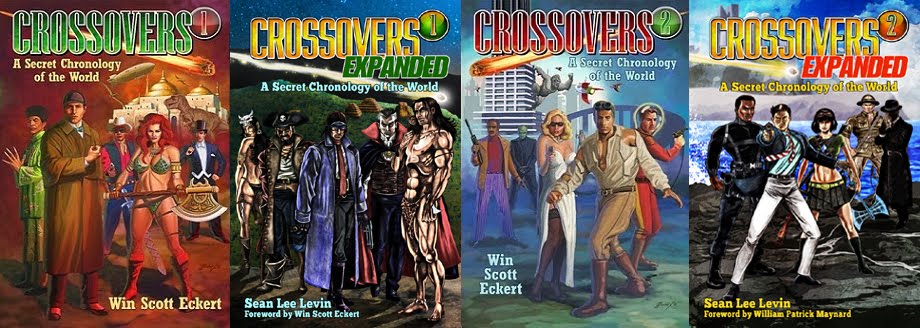
Finally, the long-awaited followups to the Crossovers books are now available for preorder from the Meteor House Press website. Now called Crossovers Expanded, they look very comparable to the original volumes, and will be shipping sometime in the late summer. The new covers look particularly slick, and so of course Sean Levin has added them to the headers of his Crossover Universe blog:

But will they have indexes?
I know I'm greatly looking forward to these, they'll be great references for a couple projects I'm working on . . .

Thursday, April 14, 2016

That Time Atomic Robo Got A Shoeshine From Short Round

So after a fairly heavy storyline in which Robo wakes up from his detour to the late nineteenth century to discover that the world in under the control of a US Government conspiracy started to oppose him, specifically, and being attacked by kaiju, the latest issue of the Atomic Robo webcomic is delving into the past for some wacky espionage shenanigans in 1938 China.

To be more precise, Robo visits the Japanese-occupied city of Shanghai, where he makes contact with a rather familiar-looking member of the resistance forces. It is, of course, Short Round, first seen rescuing Indiana Jones from gangsters in the opening of Indiana Jones and the Temple of Doom - the New York Giants hat is a dead giveaway. It only makes sense, after all, that even if he ended up spending some time acting as Indy's sidekick elsewhere in the world (he does pop up in this capacity from time to time in the Indiana Jones Expanded Universe, most notably in the sadly non-canonical Into the Great Unknown), he would return to his native Shanghai to help repel the invading Japanese. This would also explain what Short Round was doing while Indy was hunting for the Holy Grail in Indiana Jones and the Last Crusade, which also takes place in 1938.

And lest the reader think that the hat is a coincidence - it's not impossible that two such hats were floating around in Shanghai even in the 1930s - there's the little matter of the place Robo gets sent for the next meeting:

No, Robo, there is not.
While it's not quite the venerable Club Obi Wan (and yes, folks, that's a Star Wars joke), it might possibly be the same building, and it's almost certainly named after Willie Scott's memorable last performance before she got dragged into Short Round and Indy's escape. Perhaps Lao Che was in a nostalgic mood when he was doing the remodeling. We may yet find out, as Robo has yet to do more than walk in the front door of the club. Might Lao Che himself be waiting inside? It wouldn't be very much out of character for the writers of the comic - the last issue, after all, was very much a homage to Pacific Rim, while the one prior to that ended with cameo appearances from Agents West and Gordon from The Wild, Wild, West. And the name of this storyline, as it turns out, is The Temple of Od . . .

Monday, February 29, 2016

Bonne Jour Bissextile!

That's "Happy Leap Day" in French, for all my non-French-speaking readers (and if I happen to actually have any French-speaking readers, I apologize in advance and blame Google Translate).

Why French? Because following long-standing Internet Tradition, today happens to be the day for celebrating the one of the greatest French characters ever created by Marvel:

Saturday, February 06, 2016

Steampunk Sherlock

In the years since his debut, Sherlock Holmes has been a popular subject across practically every entertainment medium in existence - from his original stories, to radio shows, films, television shows both live-action and animated, and even video games, not to mention entire libraries' worth of pastiche novels.

This year, publishing company 18thwall Productions is going back to the beginning, so to speak, with a monthly series of e-novellas starring the Great Detective, replicating in a way  the original appearances of Sir Arthur Conan Doyle's' shorter Holmes pieces in magazines like The Strand.

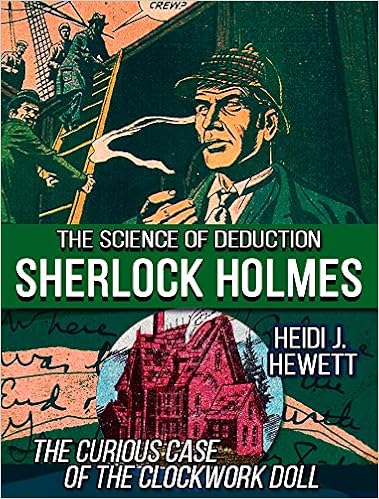
The first of these, The Curious Case of the Clockwork Doll, kicks the series off to an admirable start. The author, Heidi Hewitt, has captured Doyle's Watson-voice to a remarkable extent, and the classic elements - Baker Street, Lestrade, Holmes' eventual retirement to beekeeping- and references to other cases abound. An overabundance of these often works to the detriment of a pastiche work, but here it doesn't quite get that bad. I did question Lestrade's presence once Holmes and Watson leave London, but I suppose he also tagged along to Baskerville Hall, so perhaps his jurisdiction is flexible like that.

As the title of both the story and this post allude to, however, there's one element of this story that is distinctly un-Doyle-like - the clockwork robots that make up the client's serving staff. It takes a deft hand to add science-fiction elements like this to a historical setting without turning it into a parallel timeline, but as the story ends with the technology lost - in a fairly spectacular scene I think was the best-written in the piece - history can proceed unimpeded. The technology itself is only described in broad strokes, which makes sense as Watson is probably not up on the cutting edge of scientific theory, but a bit more explanation, even techno-babble, would have helped to sell the existence of these robots in 19th-century England, when the outpace even today's efforts.

Of course, with a mystery story the most important element is the solution, and here again is evidence of the author's painstaking craftsmanship - the denouement leaves no hanging threads (even to a seemingly unrelated robbery that I assumed was there to provide a cameo for one of the famous literary gentlemen thieves contemporary with Holmes) and, though surprising, in retrospect could have been figured out ahead of time, particularly for those with a Holmes-like memory for the details of the Sherlockian Canon. Even for readers without that, however, it was a very enjoyable story and I for one am greatly anticipating the second installment in this series.

(Disclaimer: the publisher provided me with a review copy of this story - my opinions, however, are all my own.)

Wednesday, November 11, 2015

For All Your Holmes Pastiche Needs

Thanks to a mention by Sean Levin over at the Crossover Universe blog, recently I have discovered a website that promises to be both entertaining and useful. It exists under the name Sherlock Holmes Pastiche Characters, although (as the introduction states) at this point it's really more an authoritative, if not quite exhaustive, guide to Sherlock Holmes pastiche works themselves. A remnant of the site's original purpose remains, however, in a list of "Historical & Fictional" characters - this last a great boon for the crossover researcher, especially in cases where more than one author has crossed Holmes over with the same character (perhaps not surprisingly, Count Dracula has his own page).

As if that wasn't useful enough, the site also hosts a number of specialized lists (the one recounting the non-canonical family members of Holmes and Watson is especially interesting), as well as the modestly named Indexes to Classic Sherlockian Works. This last may be the greatest page on the entire site, for two of the works that have been painstakingly indexed are none other than Crossovers I and Myths for the Modern Age. Just those two would be a find - taken as a whole, the site is a treasure trove comparable to the Agra treasure, and great thanks are due the hands that built it.