The other day I was browsing YouTube and happened across this highly amusing (if slightly-mis-titled) video:
What it lacks in not having the whole six-hour movie saga, of course, it makes up for by including snippets from the Animated Series, the Telltale video game, and even screen-shots from the tie-in comics, both the current IDW series and the old Harvey Comics stories. The inclusion of the former, by the way (not to mention the 30th anniversary short from a couple years back), makes this technically more up-to-date, if far less comprehensive, than the excellent Back in Time by Greg Mitchell.
In a way, it illustrates both the positives and negatives of opening up such a well-crafted story into an Expanded Universe. Some consistency of tone and quality is lost, a well as opening up many more opportunities for continuity errors to creep in (already a particular peril for time-travel stories). At the same time, however, the scope is greatly increased - as we see in the video, Back to the Future: The Animated Series hit many of the most popular eras of historical fiction, with pirates and dinosaurs and knights and Romans, among others. The ongoing IDW comics do the same thing for the characters, giving us such gems as Griff Tannen's 2035 employment as a police officer (!) and Doc's mid-1960s attempt to get government funding for his experiments (which somehow resulted in Marty coming back from the future only speaking Russian).
If nothing else, an active EU shows that a story like Back to the Future still resonates with the listeners, even after over 30 years. Fan projects, like this video, are another encouraging sign, and I'm glad to be able to share it.
Showing posts with label Back to the Future. Show all posts
Showing posts with label Back to the Future. Show all posts
Friday, August 18, 2017

Friday, July 03, 2015
"30 Years . . . It's a Nice Round Number"
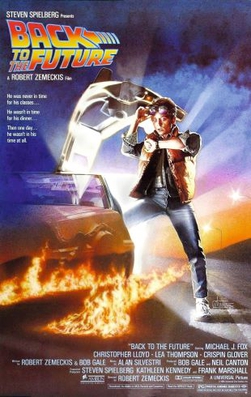
This year, 2015, is of particular interest to fans of the Back to the Future trilogy, as it's finally the year that Doc, Marty, and Jennifer visit in Part II. Obviously The Future didn't turn out much like that film showed (although we still have a few more months), although not. perhaps, for lack of trying. One thing that hasn't changed, however, is that the characters and imagery of Back to the Future is still a part of the cultural language.
But why is it, after all that time, that this movie is still so beloved - even by fans, like me, who weren't even born yet when it premiered?
Part of it, I think, is that it's very well done, technically speaking - the story, despite being science fiction of the best kind, is not particularly effects-heavy, and the effects are there succeed (mostly) at seeming realistic, even compared to today's CGI-heavy films.
Aside from the spectacle, Back to the Future also allows for criticism at a deeper level. One example of this is the continuing motif of paradox, not just in the main conflict of the story - Marty imperiling his own existence - but also in the background, such as the name of the town (Hill Valley*) and that of the movie itself. The movie also uses repetition for both humor and dramatic purposes - this is more clear across the whole trilogy, with each new era getting its own Mister Sandman Sequence, but can also be seen in just the first film - as is pointed out at that TvTropes link, Marty's trip across contemporary Hill Valley can be seen as another such sequence, inviting comparisons to all the rest.
But most of all, while clever and well-done, the most important aspect of the movie is that it is fun to watch. Comedy and drama are present in equal amounts, and even when it touches on heavier topics it does so with a light touch. There's an element of wish-fulfillment present, in that almost everyone has at least wondered what it would be like to visit another time, while simultaneously we see some of the problems - even just minor things, like Marty trying to order soft drinks that haven't been invented yet - such travel would cause. But finally, in the end, the seemingly insurmountable problems are overcome, and the adventure continues.
Oh, and the music is great, too.
* Supplementary material claims this is because the town was founded by a man named Hill, but I bet even he could see the humor in it.
Tuesday, April 01, 2014
Where's My Flying Car?
 |
| Or even a hoverboard? |
In the real world, of course, there are a myriad of reasons for this. Gravity manipulation, if even possible, is still years away, and while more mundane versions of flying cars have been developed, they still run into the problem of being much harder to use than the traditional auto.
In fiction, of course, things can get much more interesting. For example, in Captain America: The First Avenger we see Howard Stark showing off a car retrofitted with "Stark Gravitic Reversion Technology", a feat all the more impressive for being achieved in 1943.
True, it doesn't last very long, but the technology seems well-developed enough to become widespread in fairly short order. That it doesn't can, I think, be explained by this later development:
Clearly, "Gravitic Reversion" is one of the things that S.H.E.I.L.D has been keeping under wraps for all these years - Lola is, I understand, based on a 1962 model Corvette, although of course the hover-conversion could have taken place at any point subsequently. Of particular interest, to me anyway, is that Lola's transition process looks and sounds a lot like the DeLorean's. It's very tempting to conflate the two, and having hover-tech be suppressed by S.H.E.I.L.D for much of the development period explains how it becomes so widespread so soon after it becomes public.
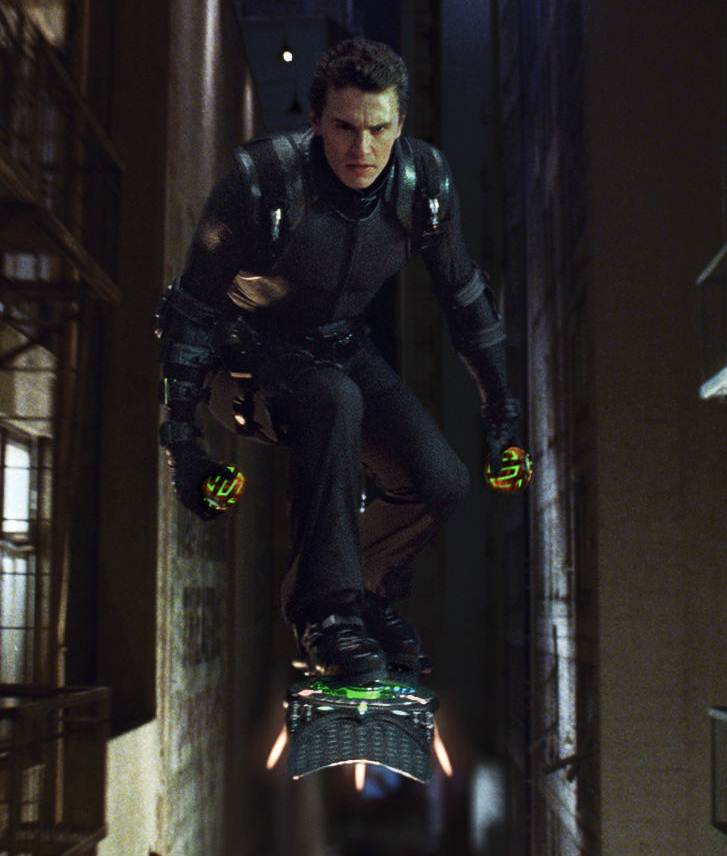 |
| OsCorp, though promising, was rejected for consideration. For obvious reasons. |
For now, though, flying cars and anti-gravity skateboards remain the stuff of fiction, looking forward to the day when we really aren't going to need roads.
Wednesday, August 15, 2012
The Secret of the Doctor's Grand-Daughter: An Exercise in Creative Mythography
About a year ago, I came across some references to a comic book hero called Atomic Robo. Although mostly appearing in print, several adventures are available for viewing online. One in particular, as soon as I began reading it, signaled to me that this was a story, and a character, I was really going to like.


No, they don't ever explain why Atomic Robo is driving B.A. Baracus' van, though I have a faint hope that the upcoming titled-but-unscheduled "Atomic Robo and the Soliders of Fortune" arc will address this.
Friday, September 03, 2010
Some Proposed Additions to the Crossover Universe Timeline
As I mentioned a few months ago, Win Scott Eckert, the driving mind behind the Wold Newton Universe website, has published a portion of the site as the extremely fascinating Crossovers: A Secret Chronology of the World. Now that Volume Two of that work has been out for a while, I figure now would be a good time to comment on it. But, instead of just reiterating all the gushing I did over Volume One*, I decided to join in the game, and share some things that I think fit nicely into the timeline Mr. Eckert has given us.
* OK, I have a bit of gushing. I was seriously pleased that a couple of fairly obscure works I happen to be familiar with made it in - namely, the Gabriel Hunt book Hunt at the Well of Eternity (which obliquely mentions Indiana Jones) and the Burn Notice novel The Fix (which mentions Crockett and Tubbs of Miami Vice). What can I say, I enjoy this kind of thing.
- 22 May 1855: A gang of thieves lead by the enigmatic Edward Pierce steal £12,000 worth of gold bullion from a railway train en route to the Crimea. It is noted that Sherlock Holmes was the only Londoner to ever memorize the entire railway schedule. From Michael Crichton's historical novel The Great Train Robbery. It's an odd thing to note about a fictional character in an unrelated novel, isn't it? Too bad Holmes was only about seventeen months old at the time of the crime.
- 5 November 1955: Marty McFly, a time traveler from 1985, is upon his arrival mistaken for a space alien, due to his unfortunate resemblance to the cover illustration of Tales From Space, a comic book owned by one of the witnesses to his arrival, one Sherman Peabody. From the 1985 film Back to the Future. This particular issue of Tales From Space was apparently quite popular, as it was reprinted at least once during the next half-century.
- 25 August 1967: A little girl is kidnapped from Innsmouth by (as it transpires) an inhabitant of the underwater city of Rapture. From There's Something In The Sea, the online background for the video game BioShock 2. Curiously, the reports from this event put Innsmouth in Rhode Island instead of Massachusetts, but as there's no actual town by that name in Rhode Island either, I'm chalking it up to either a subtle misdirection by the game developers or a transcription error by Mark Meltzer.
- November 1986: The Notion Club, a literary society from Oxford, discusses the fictionalized account of Dr. Elwin Ransom's 1938 journey to Mars. From J.R.R. Tolkien's unfinished Notion Club Papers. In addition to mentioning Ransom's book Out of the Silent Planet, the Papers also discuss the Club member's psychic encounters with Numenor, strengthening the connection with the Cosmic Trilogy.
- 1998: Visiting extraterrestrial Harry Solomon reads a familiar-looking Tales From Space comic. From the "3rd Rock From the Sun" episode "The House That Dick Built". This appearance establishes a link among that TV show, Back to the Future, and Heroes.
- Autumn 2005: While fighting some vampires, Chicago-based wizard Harry Dresden tells Inari Raith to "make like Buffy". Later in the fight he tries to stab a vampire with his broken blasting rod, "Buffy-like". From Jim Butcher's "Dresden Files" novel Blood Rites. The connection to "Buffy the Vampire Slayer" is somewhat tenuous, since the reference is immediately followed by Harry thinking that staking vampires with broken sticks "works better on television". Still, Harry never does come out and say that Buffy Summers is only a TV character, and while later in the series Thomas does wear a Buffy T-Shirt . . . so has Buffy.
- 7 - 10 October 2006: Several people read the Tales From Space comic first seen in 1955, including technopath Micah Sanders and an unnamed student at Union Wells High School. From the television show "Heroes", which provides the major link to the Back to the Future series.
- Summer 2011: Harry Dresden muses that the universe contains "terrors that the Black-Goat-with-a-Thousand-Young wouldn't dare use for its kids' bedtime stories." From the Dresden Files novel Turn Coat. "The Black-Goat-with-a-Thousand-Young" is, of course, one of the titles of the Lovecraftian entity Shub-Niggurath. This reference also serves to strengthen the admittedly weak connection with "Buffy the Vampire Slayer", since that series has many Lovecraft overtones.
- 2370: A graveyard on the Federation colony world of Caldos II contains a marker inscribed "McFly". From the Star Trek: The Next Generation episode "Sub Rosa". Given the manufactured Scottish culture present in the colony, it's not impossible that some descendants of the Irish-derived McFly family of Hill Valley might choose to settle there. And we already know that Marty's descendants take to the stars fairly early on . . .
* OK, I have a bit of gushing. I was seriously pleased that a couple of fairly obscure works I happen to be familiar with made it in - namely, the Gabriel Hunt book Hunt at the Well of Eternity (which obliquely mentions Indiana Jones) and the Burn Notice novel The Fix (which mentions Crockett and Tubbs of Miami Vice). What can I say, I enjoy this kind of thing.
Subscribe to:
Posts (Atom)


 Posts
Posts


