Showing posts with label Sherlock Holmes. Show all posts

Saturday, February 06, 2016

Steampunk Sherlock

In the years since his debut, Sherlock Holmes has been a popular subject across practically every entertainment medium in existence - from his original stories, to radio shows, films, television shows both live-action and animated, and even video games, not to mention entire libraries' worth of pastiche novels.

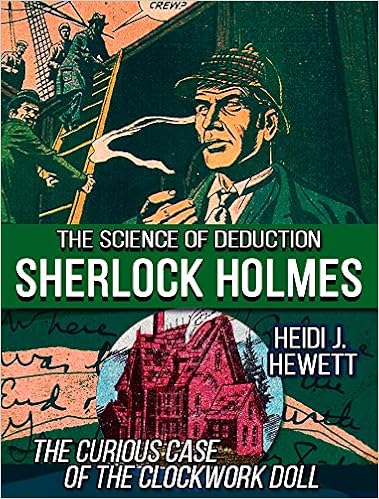
This year, publishing company 18thwall Productions is going back to the beginning, so to speak, with a monthly series of e-novellas starring the Great Detective, replicating in a way  the original appearances of Sir Arthur Conan Doyle's' shorter Holmes pieces in magazines like The Strand.

The first of these, The Curious Case of the Clockwork Doll, kicks the series off to an admirable start. The author, Heidi Hewitt, has captured Doyle's Watson-voice to a remarkable extent, and the classic elements - Baker Street, Lestrade, Holmes' eventual retirement to beekeeping- and references to other cases abound. An overabundance of these often works to the detriment of a pastiche work, but here it doesn't quite get that bad. I did question Lestrade's presence once Holmes and Watson leave London, but I suppose he also tagged along to Baskerville Hall, so perhaps his jurisdiction is flexible like that.

As the title of both the story and this post allude to, however, there's one element of this story that is distinctly un-Doyle-like - the clockwork robots that make up the client's serving staff. It takes a deft hand to add science-fiction elements like this to a historical setting without turning it into a parallel timeline, but as the story ends with the technology lost - in a fairly spectacular scene I think was the best-written in the piece - history can proceed unimpeded. The technology itself is only described in broad strokes, which makes sense as Watson is probably not up on the cutting edge of scientific theory, but a bit more explanation, even techno-babble, would have helped to sell the existence of these robots in 19th-century England, when the outpace even today's efforts.

Of course, with a mystery story the most important element is the solution, and here again is evidence of the author's painstaking craftsmanship - the denouement leaves no hanging threads (even to a seemingly unrelated robbery that I assumed was there to provide a cameo for one of the famous literary gentlemen thieves contemporary with Holmes) and, though surprising, in retrospect could have been figured out ahead of time, particularly for those with a Holmes-like memory for the details of the Sherlockian Canon. Even for readers without that, however, it was a very enjoyable story and I for one am greatly anticipating the second installment in this series.

(Disclaimer: the publisher provided me with a review copy of this story - my opinions, however, are all my own.)

Wednesday, November 11, 2015

For All Your Holmes Pastiche Needs

Thanks to a mention by Sean Levin over at the Crossover Universe blog, recently I have discovered a website that promises to be both entertaining and useful. It exists under the name Sherlock Holmes Pastiche Characters, although (as the introduction states) at this point it's really more an authoritative, if not quite exhaustive, guide to Sherlock Holmes pastiche works themselves. A remnant of the site's original purpose remains, however, in a list of "Historical & Fictional" characters - this last a great boon for the crossover researcher, especially in cases where more than one author has crossed Holmes over with the same character (perhaps not surprisingly, Count Dracula has his own page).

As if that wasn't useful enough, the site also hosts a number of specialized lists (the one recounting the non-canonical family members of Holmes and Watson is especially interesting), as well as the modestly named Indexes to Classic Sherlockian Works. This last may be the greatest page on the entire site, for two of the works that have been painstakingly indexed are none other than Crossovers I and Myths for the Modern Age. Just those two would be a find - taken as a whole, the site is a treasure trove comparable to the Agra treasure, and great thanks are due the hands that built it.

Friday, July 27, 2012

Holmes for the Holidays

Something I've noticed over the past several months in my reading and film-watching habits recently has been a sharp increase in stories starring Sherlock Holmes. While I've long been a fan of the Greatest Detective, these things tend to come in waves, and right now the Holmes-wave is cresting.

Most obviously, the arrival of Sherlock Holmes: A Game of Shadows in theaters last December was an occasion of some welcome. I see that the first Guy Ritchie-directed Holmes adaptation came out during my own hiatus, and thus went uncommented on. I'll just take this opportunity to say that I found it an excellent movie, one that hewed close to the spirit of Doyle's stories, if not being perfectly accurate in every detail.

And I swear the tagline is an amusing coincidence.

The sequel is the pretty much the same, only more so. I do have a few quibbles with it - the liberties taken with the storyline were somewhat more noticeable, given that the film was adapting an existing Holmes story rather than making one out of whole cloth. I was also rather irritated at the fate of Irene Adler in the film, though I take some comfort from the fact that we never saw the body. So to speak.

Holmes and Watson, though, were in top form. Especially gratifying was the expanded use of Holmes' "plot-out-the-fight-in-slow-motion-in-advance" brawling technique, even considering the time that Holmes' meticulous sequence was derailed by a third party throwing a knife. And of course, his final encounter with Moriarty took this form as well, with amazing results. And let's not forget Watson -  I especially appreciated his use of deductive reasoning concerning Mycroft's appearance at his "bachelor party", as well as his penultimate confrontation with Colonel Moran.

Finally, I thought Jared Harris' portrayal of Professor Moriarty to be pretty good, with just the right amount of civility papering over seething menace. His plot was refreshingly prosaic, though it reminded me quite a bit - OK, it was pretty much identical - to the Fantom's plot in The League of Extraordinary Gentlemen. And we all know who he turned out to be:

Friday, July 01, 2011

30 Day Book Challenge - Day 5

So, yeah, at this point it's pretty obvious I'm not going to be doing all 30 of these in June. Sorry about that.


Day 5 – A Book That Makes You Happy

Observant and regular readers will have probably noticed by this point that one of the things I look for in my fiction is coherent (or at least interesting) world-building. The acknowledged grandmaster of this, of course, is J.R.R. Tolkien; he even coined some of the terminology associated with this, such as "Secondary World" and "sub-creation".

Some authors and other scholars take this one step farther - treating their favorite stories as the lightly-fictionalized records of real events, analyzing broad swathes of literature to uncover the "true" events behind them, and connecting them. This game has been played with popular literature for quite some time, and has interested me ever since I first heard of it. Indeed, I've even dabbled in The Game myself, and was actually intending to make this post about Crossovers.

Then, I finally manged to get ahold of a copy of Myths for the Modern Age, a collection of essays exploring this kind of "Tertiary World"-building, edited by the same Win Scott Eckert as is behind Crossovers. As a compilation, naturally there are some pieces that are more interesting than others - for example, one of the early pieces, "Wold-Newtonry: Theory and Methodology for the Literary Archeology of the Wold Newton Universe"is a particular favorite of mine; not least because of the delightful phrase, "literary archeology".

But that's not the article that convinced me to use the book for this post - that honor falls to Eckert's own "Who's Going to Take Over the World When I'm Gone?", a genealogical* study of the Moriarty family. Imagine my delight and surprise when, seemingly out of the blue, the article mentions how one of the Professor's grandchildren is none other than Howling Mad Murdock of The A-Team (the television version, obviously). Since Murdock is pretty much my favorite A-Team member, and The A-Team itself one of my favorite television shows, I was quite pleased at this.

Amongst other amusing tidbits from that section was the idea that Murdock's first name is "Hamish" - in the show, Murdock is never given a first name, only an initial. And why is this so amusing? Because the name "Hamish" is a variant form of "James", which according to Sir Arthur Conan Doyle was the first name of both Professor Moriarty and at least one of his brothers (the cavalier attitude some famous authors take towards continuity is part of what makes this kind of fandom so entertaining).

As if Murdock wasn't enough, both Eckert's article and a later one by Brad Mengel ("Watching the Detectives, Or, The Sherlock Holmes Family Tree") both theorize that Hannibal Smith was the son of Fu Manchu's great nemesis, Sir Denis Nayland Smith. Furthermore, it seems that Hannibal's grandfather was Fu Manchu himself (through his mother Fah lo Suee) - this Asian ancestry no doubt explains how Hannibal kept getting away with his "Mr. Lee the Chinese Laundry Man" persona.


This is a much better disguise in real life.

While the inclusion of half the A-Team is what qualified Myths for the Modern Age as a Book That Makes Me Happy, there's plenty of other good material to be found within. Admittedly, much of it is available on Eckert's Wold Newton Universe website, though I understand the published versions are more up-to-date. Indeed, a quick poke around the site shows that it includes only Hannibal's inclusion, not Murdock's. This is no criticism, merely an acknowledgement that the two sources are different - and it will surely inspire me to acquire my own copy of Myths, from a source other than the library.

*Genealogical studies linking various fictional characters being one of the major features of Wold Newton Universe scholarship.

Friday, November 19, 2010

Welcome to Today

There are few things more irritating in the pop-cultural world than a bad adaptation of a beloved work. One early warning sign is often that a period work has been moved to the modern day - this can signal that the producers either don't know much about the work beyond what can be gleaned from the title, or are attempting to make it more "relevant". Now, while a modernized work isn't always bad (V for Vendetta was originally set in the 1990's, after all), it does generate controversy amongst fans of the original work (not everybody liked V for Vendetta, and amongst those that didn't the most common reason seems to be that it wasn't enough like the comic).

Given all this, it is understandable why I was skeptical about Sherlock, a recent BBC production that brings Sherlock Holmes to modern London. However, the responses from viewers across the pond were mostly positive, so a few weeks ago when the first of three episodes season aired on PBS, I made sure to check it out.

That first episode, "A Study In Pink", turned out to be an excellent retelling of Sir Arthur Conan Doyle's first Sherlock Holes story, with just enough twists and reversals to make it both fresh and familiar to fans of the original. And not just in the actual mystery, either - from Sherlock's first complaint that it's "impossible to sustain a smoking habit in London these days" (not to mention his "three-patch" solution), it's clear that this Holmes is going to both keep everything that made the original unique, while not glossing over the things about the modern world that Holmes would have to adapt to.

One particularly interesting example of this from the first episode occurs when Sherlock, gleefully rushing out of 221B to the scene of another grisly crime, calls out to Dr. Watson that "The game . . . is on!" Of course, fans of the original Holmes would be expecting him to say, "The game's afoot!", but in a universe where there was no Sherlock Holmes until the late 20th century, there would be little reason for that phrase to stick in the public consciousness. Replacing it with "The game is on!" is not only a nice little reminder of the paradox involved in Holmes & Watson's temporal displacement, but another clever way to modernize the character.

The rest of the season, while not following any particular Holmes cases as closely as the pilot, do measure up to the high bar set by the pilot. The middle one, "The Blind Banker", is the least of the three, but I attribute this to it's being the only episode in the season that isn't a season premiere or finale. "The Great Game", that finale, introduces Sherlock's great nemesis, "Jim" Moriarty. The show plays up Moriarty's being Sherlock's opposite (a consulting criminal as opposed to a consulting detective) at the expense of what we knew of him from the stories (although, there's nothing to say that Colonel Moran wasn't at the other end of one of those laser sights . . . ), he was still very well done.

Of course, then the season ended with one of the worse cliffhangers since Captain Picard got assimilated by the Borg, but I understand that a second season will be coming . . . sometime next year. Sigh.

One last, tangential note. Apparently, Dr. Watson - or more accurately, his actor Martin Freeman - has been cast as Bilbo Baggins in Peter Jackson's long-awaited film version of "the Hobbit". Hmm - Bilbo, Watson, Arthur Dent - does anyone else notice a theme here?