The other day I was browsing YouTube and happened across this highly amusing (if slightly-mis-titled) video:
What it lacks in not having the whole six-hour movie saga, of course, it makes up for by including snippets from the Animated Series, the Telltale video game, and even screen-shots from the tie-in comics, both the current IDW series and the old Harvey Comics stories. The inclusion of the former, by the way (not to mention the 30th anniversary short from a couple years back), makes this technically more up-to-date, if far less comprehensive, than the excellent Back in Time by Greg Mitchell.
In a way, it illustrates both the positives and negatives of opening up such a well-crafted story into an Expanded Universe. Some consistency of tone and quality is lost, a well as opening up many more opportunities for continuity errors to creep in (already a particular peril for time-travel stories). At the same time, however, the scope is greatly increased - as we see in the video, Back to the Future: The Animated Series hit many of the most popular eras of historical fiction, with pirates and dinosaurs and knights and Romans, among others. The ongoing IDW comics do the same thing for the characters, giving us such gems as Griff Tannen's 2035 employment as a police officer (!) and Doc's mid-1960s attempt to get government funding for his experiments (which somehow resulted in Marty coming back from the future only speaking Russian).
If nothing else, an active EU shows that a story like Back to the Future still resonates with the listeners, even after over 30 years. Fan projects, like this video, are another encouraging sign, and I'm glad to be able to share it.
Showing posts with label film. Show all posts
Showing posts with label film. Show all posts
Friday, August 18, 2017

Thursday, September 08, 2016
Fifty Years of Favorite Star Trek Moments

On this very night fifty years ago - Thursday, September 8, 1966 - an episode of a new science fiction television show beamed into American televisions for the very first time. When it was cancelled just three seasons later, nobody involved suspected that Star Trek would become the beloved cultural juggernaut that it has. While I've enjoyed all the different versions of Trek over the years, a large proportion of my personal favorites, no matter the decade, seem to involve the original crew:
Monday, February 29, 2016
Bonne Jour Bissextile!
That's "Happy Leap Day" in French, for all my non-French-speaking readers (and if I happen to actually have any French-speaking readers, I apologize in advance and blame Google Translate).
Why French? Because following long-standing Internet Tradition, today happens to be the day for celebrating the one of the greatest French characters ever created by Marvel:
Why French? Because following long-standing Internet Tradition, today happens to be the day for celebrating the one of the greatest French characters ever created by Marvel:
Friday, July 03, 2015
"30 Years . . . It's a Nice Round Number"
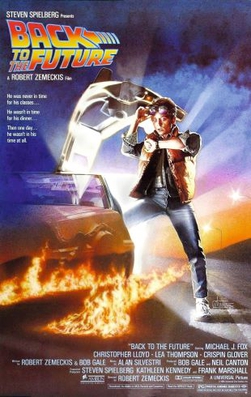
This year, 2015, is of particular interest to fans of the Back to the Future trilogy, as it's finally the year that Doc, Marty, and Jennifer visit in Part II. Obviously The Future didn't turn out much like that film showed (although we still have a few more months), although not. perhaps, for lack of trying. One thing that hasn't changed, however, is that the characters and imagery of Back to the Future is still a part of the cultural language.
But why is it, after all that time, that this movie is still so beloved - even by fans, like me, who weren't even born yet when it premiered?
Part of it, I think, is that it's very well done, technically speaking - the story, despite being science fiction of the best kind, is not particularly effects-heavy, and the effects are there succeed (mostly) at seeming realistic, even compared to today's CGI-heavy films.
Aside from the spectacle, Back to the Future also allows for criticism at a deeper level. One example of this is the continuing motif of paradox, not just in the main conflict of the story - Marty imperiling his own existence - but also in the background, such as the name of the town (Hill Valley*) and that of the movie itself. The movie also uses repetition for both humor and dramatic purposes - this is more clear across the whole trilogy, with each new era getting its own Mister Sandman Sequence, but can also be seen in just the first film - as is pointed out at that TvTropes link, Marty's trip across contemporary Hill Valley can be seen as another such sequence, inviting comparisons to all the rest.
But most of all, while clever and well-done, the most important aspect of the movie is that it is fun to watch. Comedy and drama are present in equal amounts, and even when it touches on heavier topics it does so with a light touch. There's an element of wish-fulfillment present, in that almost everyone has at least wondered what it would be like to visit another time, while simultaneously we see some of the problems - even just minor things, like Marty trying to order soft drinks that haven't been invented yet - such travel would cause. But finally, in the end, the seemingly insurmountable problems are overcome, and the adventure continues.
Oh, and the music is great, too.
* Supplementary material claims this is because the town was founded by a man named Hill, but I bet even he could see the humor in it.
Friday, August 16, 2013
Where Someone Has Gone Before

They're also pretty spoilery, so if you haven't seen it yet you probably want to take care of that before venturing below the cut.
Thursday, July 11, 2013
A League Of Its Own

Sadly, the world in general does not appear to share my enthusiasm. I tend to attribute this to rampant Alan Moore fandom - he famously doesn't get on well with adaptations of his work, and LXG admittedly took rather a few more liberties than an adaptation can typically support.
But in this case, however, I think the changes work quite well. Certainly they don't distract from making the movie enjoyable to watch, in itself, and one of the chief delights of cameo- and reference-spotting remain intact.
Indeed, I credit The League Of Extraordinary Gentlemen with helping to form my current interest in crossovers and shared universes, most notably the Wold Newton Universe (to which the League is tangentially related).
Anyway. I've always enjoyed the movie, and was quite disappointed a few years later when LXG2: War of the Worlds failed to materialize. Almost unbelievably, it seems that the concept might still have a chance - there are some early reports that Fox is developing the League as a television show. Details at this time are sketchy - not even to determine whether this is a reboot or a continuation of the film continuity - but I'm hopeful that whatever comes from he project will be at least as enjoyable as the movie is to me.
Tuesday, May 14, 2013
The Avengers, and Other Marvelous Things
So yes, this is old news, but The Avengers is amazing. It takes everything that was good about the previous half-dozen Marvel Cinematic Universe movies, and concentrates it down into two-and-a-half hours of what may be the best superhero movie to date.
If I had to pick one word to sum up the film, I think I would choose balanced. There are several ways that this is relevant - in terms of spectacle vs. plot, for example, the movie manages to excel at the former without it being (as is too often the case) at the expense of the latter. Also applicable is the way the film balanced the hitherto unprecedented - so far as I'm aware - team-up of heroes who previously carried four individual franchises, a feat made even more extraordinary by its success. Each one got some time in the spotlight, simultaneously continuing their stories from previous outings and emerging ready to slip back into solo-dom with minimal disruption.
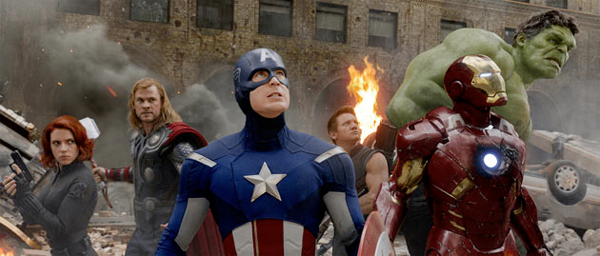
Iron Man, having had around 100% more prior movie time than almost any of his team-mates, seemed to me to be the most static in terms of development, though his introduction would certainly seem to indicate his relationship with Pepper has developed from what I remember. There was also that nifty armor upgrade, which makes a nice midpoint between the backpack-armor we saw in Iron Man 2 and Iron Man 3's rumored nano-tech-armor. Finally, he did have a bit of a character arc in his response to Captain America's remarks about sacrifice, and I really liked the way he insisted on interacting with Dr. Banner as a fellow scientist rather than a potential Hulk.
Speaking of the Hulk, in some ways he had the most to overcome, with his multiple actors and somewhat uneven prior films. In a lot of ways, however, he was the breakout star of the film - certainly he was responsible for many of the film's most popular moments (such as the punching the first giant robot dragon-fish, and of course his "Puny god" line). Would these moments be enough to carry a solo film? I'm sure we'll find out eventually, but in the meantime I'm looking forward to Hulk and/or Dr. Banner making cameos in his team-mates' movies. I'd like to think, giving him going off with Tony at the end of Avengers, that Iron Man III is the most likely candidate for this, but given the trailers and early reactions to III so far I'm not holding my breath.
Other solo sequels are sounding equally good. Despite the fact that Thor was not really my favorite of the "Phase One" Marvel films, I'm very excited about the direction that the sequel is taking. Of course, part of this is because I somewhat jokingly predicted this back when the first film came out, but hey - Space Elves are cool anytime. Thor's appearance in The Avengers itself was not quite that exciting, unfortunately - his biggest roles, it seemed, were facilitating hero-on-hero brawls and contributing secondary characters, namely Loki and Dr. Selvig. Not that either of those is unimportant, but they just didn't have quite the same focus as some of the other members. It didn't help that Thor was the one who delivered what I thought was the worst line in the movie - though funny, "He's adopted" was a rather out-of-character statement, in more ways than one.
Rounding out the "Big Four" of the team is Captain America whom, more than the others, ended his last solo film on a bit of a cliffhanger. He didn't get a whole lot of a chance to catch his breath and adjust to the 21st century, either, though there are a few signs that such an adjustment is taking place - note his mention of feeling at home on the Helicarrier. More than adjusting to the times, though, we saw Cap adjusting to being part of a different team than he was used to.
 This will be important later, as 2014's scheduled film Captain America: The Winter Soldier sounds like it will feature not only the titular Solider (no spoilers, but that title's a giveaway for something we all knew would happen), but also Black Widow and a new hero, the Falcon. How exactly this will shake out remains to be seen, but it can't be harder than Cap learning to work with Tony and Thor (the latter of whom, incidentally, prompted Cap to utter my absolute favorite line in the whole film: "There's only one God, Ma'am, and I'm pretty sure He doesn't dress like that").
For all the appropriateness of Black Widow appearing in Winter Solider, it does seem a shame that it probably means she won't be getting her own movie. Both she and Hawkeye, in fact, managed the jump from "secondary character" to "ensemble lead" quite well, especially considering the latter's post-production introduction into Thor. Spending half the film mind-controlled was perhaps a bit of a heavy-handed way to generate audience sympathy for a relative unknown, but revealing and drawing on a shared past with Natasha made his integration surprisingly easy. And of course the Widow herself had a great second appearance, being an effective Avenger even with a slightly out-of-genre skillset.
Finally, Agent Coulson. From the moment that Joss Whedon was revealed as the film's director, speculation ran rampant that Phil "First Name Is Agent" Coulson wouldn't make it through the film. It was such an obvious ploy that when it actually happened, I was actually a little surprised. That didn't make it any less meaningful, of course, either to the audience or the other characters - it helped that Phil had some great character-building scenes before getting killed, especially the ones opposite Captain America.
Happily, in true comic-book fashion it appears that the Son of Coul has cheated death (exact method unknown, though I lean towards the "Nick Fury exaggerated the extent of his injuries to give the team something to Avenge" theory) and will be taking the lead in a Marvel Cinematic Universe TV show, Agents of S.H.I.E.L.D:
Not quite the SHIELD movie I was hoping for, but it has promise. I'm especially intrigued by the idea of the apparently anti-SHIELD organization The Rising Tide. Other details are sketchy at the moment but I'm definitely willing to give this show a try.
In a way, The Avengers was really a transition point not only in the development of the MCU, but the superhero-film industry generally. The effects of showing that such an elaborate project could not only work, but work well, remain to be seen - but in the meanwhile, bring on Phase II!
EDIT: Typically, just a few hours after I posted this another, much longer promo for Agents of S.H.I.E.L.D went up. My interest is not reduced:
If I had to pick one word to sum up the film, I think I would choose balanced. There are several ways that this is relevant - in terms of spectacle vs. plot, for example, the movie manages to excel at the former without it being (as is too often the case) at the expense of the latter. Also applicable is the way the film balanced the hitherto unprecedented - so far as I'm aware - team-up of heroes who previously carried four individual franchises, a feat made even more extraordinary by its success. Each one got some time in the spotlight, simultaneously continuing their stories from previous outings and emerging ready to slip back into solo-dom with minimal disruption.
Iron Man, having had around 100% more prior movie time than almost any of his team-mates, seemed to me to be the most static in terms of development, though his introduction would certainly seem to indicate his relationship with Pepper has developed from what I remember. There was also that nifty armor upgrade, which makes a nice midpoint between the backpack-armor we saw in Iron Man 2 and Iron Man 3's rumored nano-tech-armor. Finally, he did have a bit of a character arc in his response to Captain America's remarks about sacrifice, and I really liked the way he insisted on interacting with Dr. Banner as a fellow scientist rather than a potential Hulk.
 |
| Then again, Hulkbuster! |
Other solo sequels are sounding equally good. Despite the fact that Thor was not really my favorite of the "Phase One" Marvel films, I'm very excited about the direction that the sequel is taking. Of course, part of this is because I somewhat jokingly predicted this back when the first film came out, but hey - Space Elves are cool anytime. Thor's appearance in The Avengers itself was not quite that exciting, unfortunately - his biggest roles, it seemed, were facilitating hero-on-hero brawls and contributing secondary characters, namely Loki and Dr. Selvig. Not that either of those is unimportant, but they just didn't have quite the same focus as some of the other members. It didn't help that Thor was the one who delivered what I thought was the worst line in the movie - though funny, "He's adopted" was a rather out-of-character statement, in more ways than one.
Rounding out the "Big Four" of the team is Captain America whom, more than the others, ended his last solo film on a bit of a cliffhanger. He didn't get a whole lot of a chance to catch his breath and adjust to the 21st century, either, though there are a few signs that such an adjustment is taking place - note his mention of feeling at home on the Helicarrier. More than adjusting to the times, though, we saw Cap adjusting to being part of a different team than he was used to.
This will be important later, as 2014's scheduled film Captain America: The Winter Soldier sounds like it will feature not only the titular Solider (no spoilers, but that title's a giveaway for something we all knew would happen), but also Black Widow and a new hero, the Falcon. How exactly this will shake out remains to be seen, but it can't be harder than Cap learning to work with Tony and Thor (the latter of whom, incidentally, prompted Cap to utter my absolute favorite line in the whole film: "There's only one God, Ma'am, and I'm pretty sure He doesn't dress like that").For all the appropriateness of Black Widow appearing in Winter Solider, it does seem a shame that it probably means she won't be getting her own movie. Both she and Hawkeye, in fact, managed the jump from "secondary character" to "ensemble lead" quite well, especially considering the latter's post-production introduction into Thor. Spending half the film mind-controlled was perhaps a bit of a heavy-handed way to generate audience sympathy for a relative unknown, but revealing and drawing on a shared past with Natasha made his integration surprisingly easy. And of course the Widow herself had a great second appearance, being an effective Avenger even with a slightly out-of-genre skillset.
Finally, Agent Coulson. From the moment that Joss Whedon was revealed as the film's director, speculation ran rampant that Phil "First Name Is Agent" Coulson wouldn't make it through the film. It was such an obvious ploy that when it actually happened, I was actually a little surprised. That didn't make it any less meaningful, of course, either to the audience or the other characters - it helped that Phil had some great character-building scenes before getting killed, especially the ones opposite Captain America.
Happily, in true comic-book fashion it appears that the Son of Coul has cheated death (exact method unknown, though I lean towards the "Nick Fury exaggerated the extent of his injuries to give the team something to Avenge" theory) and will be taking the lead in a Marvel Cinematic Universe TV show, Agents of S.H.I.E.L.D:
Not quite the SHIELD movie I was hoping for, but it has promise. I'm especially intrigued by the idea of the apparently anti-SHIELD organization The Rising Tide. Other details are sketchy at the moment but I'm definitely willing to give this show a try.
In a way, The Avengers was really a transition point not only in the development of the MCU, but the superhero-film industry generally. The effects of showing that such an elaborate project could not only work, but work well, remain to be seen - but in the meanwhile, bring on Phase II!
EDIT: Typically, just a few hours after I posted this another, much longer promo for Agents of S.H.I.E.L.D went up. My interest is not reduced:
Thursday, January 03, 2013
The Long-Expected Prequel
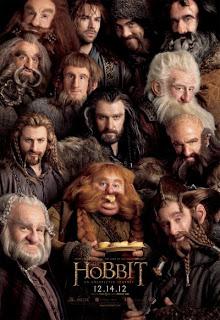
Spoiler: It was, it definitely was.
Friday, July 27, 2012
Holmes for the Holidays
Something I've noticed over the past several months in my reading and film-watching habits recently has been a sharp increase in stories starring Sherlock Holmes. While I've long been a fan of the Greatest Detective, these things tend to come in waves, and right now the Holmes-wave is cresting.
Most obviously, the arrival of Sherlock Holmes: A Game of Shadows in theaters last December was an occasion of some welcome. I see that the first Guy Ritchie-directed Holmes adaptation came out during my own hiatus, and thus went uncommented on. I'll just take this opportunity to say that I found it an excellent movie, one that hewed close to the spirit of Doyle's stories, if not being perfectly accurate in every detail.

The sequel is the pretty much the same, only more so. I do have a few quibbles with it - the liberties taken with the storyline were somewhat more noticeable, given that the film was adapting an existing Holmes story rather than making one out of whole cloth. I was also rather irritated at the fate of Irene Adler in the film, though I take some comfort from the fact that we never saw the body. So to speak.
Holmes and Watson, though, were in top form. Especially gratifying was the expanded use of Holmes' "plot-out-the-fight-in-slow-motion-in-advance" brawling technique, even considering the time that Holmes' meticulous sequence was derailed by a third party throwing a knife. And of course, his final encounter with Moriarty took this form as well, with amazing results. And let's not forget Watson - I especially appreciated his use of deductive reasoning concerning Mycroft's appearance at his "bachelor party", as well as his penultimate confrontation with Colonel Moran.
Finally, I thought Jared Harris' portrayal of Professor Moriarty to be pretty good, with just the right amount of civility papering over seething menace. His plot was refreshingly prosaic, though it reminded me quite a bit - OK, it was pretty much identical - to the Fantom's plot in The League of Extraordinary Gentlemen. And we all know who he turned out to be:
Most obviously, the arrival of Sherlock Holmes: A Game of Shadows in theaters last December was an occasion of some welcome. I see that the first Guy Ritchie-directed Holmes adaptation came out during my own hiatus, and thus went uncommented on. I'll just take this opportunity to say that I found it an excellent movie, one that hewed close to the spirit of Doyle's stories, if not being perfectly accurate in every detail.
And I swear the tagline is an amusing coincidence.
The sequel is the pretty much the same, only more so. I do have a few quibbles with it - the liberties taken with the storyline were somewhat more noticeable, given that the film was adapting an existing Holmes story rather than making one out of whole cloth. I was also rather irritated at the fate of Irene Adler in the film, though I take some comfort from the fact that we never saw the body. So to speak.
Holmes and Watson, though, were in top form. Especially gratifying was the expanded use of Holmes' "plot-out-the-fight-in-slow-motion-in-advance" brawling technique, even considering the time that Holmes' meticulous sequence was derailed by a third party throwing a knife. And of course, his final encounter with Moriarty took this form as well, with amazing results. And let's not forget Watson - I especially appreciated his use of deductive reasoning concerning Mycroft's appearance at his "bachelor party", as well as his penultimate confrontation with Colonel Moran.
Finally, I thought Jared Harris' portrayal of Professor Moriarty to be pretty good, with just the right amount of civility papering over seething menace. His plot was refreshingly prosaic, though it reminded me quite a bit - OK, it was pretty much identical - to the Fantom's plot in The League of Extraordinary Gentlemen. And we all know who he turned out to be:
Saturday, April 28, 2012
The Good, The Bad, and The Dwarven
So, just in case there's anyone left on the Internet who hasn't heard the news, we have now seen a teaser trailer for The Hobbit: An Unexpected Journey:
I have to say, I'm pretty impressed, and my excitement for the movie has been upped by several levels.
I have to say, I'm pretty impressed, and my excitement for the movie has been upped by several levels.
Monday, September 12, 2011
So, Cowboys & Aliens . . .
. . . has come and gone from the theaters, and I've had some time to mull over my reaction to it. I'd been anticipating the movie for quite some time, and was frankly a little bit underwhelmed. Don't get me wrong, there's nothing I can point to as being bad about this movie - well, nothing major, anyway - but I have, nonetheless, an unsettling feeling that something was off. Maybe my expectations were just too high.
Anyway, despite my vague dis-satisfaction, this film still did - and did well - what it set out to do, namely take a typical Western and turn it on it's ear by introducing invading aliens. Now, I'm not very familiar with the Western as a genre - I've often said my favorite example of such is Back to the Future Part III - but prior to the first alien attack, it seemed that we were all set for a stereotypical - and probably literal - showdown between the anti-heroic drifter* and the corrupt cattle baron that rules the town with an iron fist.

In their own ways, over the course of the film after the alien attack both Jake and Colonel Dolarhyde transcend the stereotypes they start out as. For Jake this is mostly a matter of slowly recovering his lost memory (though the closing scene indicates that he's given up outlawry), but Dolarhyde has a much more dynamic character arc.
He begins as a straight-up antagonist, first seen torturing one of his own employees over some incinerated cattle (for some reason, he doesn't believe the hapless cowpoke's claim that the herd caught fire while he was falling in the river), then stomping into town to demand that the sheriff give him Jake (who did him some as-yet-unspecified injury) and Percy (his bratty son) instead of sending them to the Marshal, as the law requires.
As badly displayed as it is, this kernel of goodness - Dolarhyde's love for his son - is ultimately the catalyst for his redemption. In particular, Percy's capture by the aliens spurs him into leading the posse to track them down, thus forcing him to co-operate not only with a gang of outlaws that robbed him, but with the local Apaches. This is particularly eye-opening for Dolarhyde, as some of his employees are Apaches - and one in particular, Nat, seems to have great respect for Dolarhyde, and at one point brings up a tale of his deeds during the Civil War. Unfortunately, Dolarhyde does not appreciate this, gruffly telling him that the stories "weren't for you, they were for my son."
It is a big sign of Dolarhyde's development, then, that later on, as Nat lays dying, Dolarhyde tells him that "I always dreamed of having a son like you." Conveniently, when Percy is rescued from the aliens he's displaying the same amnesia that Jake had, which means that Dolarhyde has been given something of a second chance with him. It is, I suspect, not accidental that the name of their town is "Absolution".
In contrast to these weighty matters, a lot of the film, including the parts with the actual aliens, is actually quite light. In part, this comes from attempts to draw comparisons between the aliens and the cowboys - the worst example is probably the Space Lassos with which the townsfolk are abducted. Thankfully, almost nothing else is quite this campy**, and it's actually somewhat refreshing to have the alien's motivation be something as mundane as gold (of course, they may need it for industrial purposes and not, as Dolarhyde hilariously assumes, as currency).
The film did have a couple other mis-steps, such as the aliens' seemingly variable vulnerability to gunfire and/or bladed weapons. Another thing that bugged me was the upside-down ship in the middle of the desert - not that it wasn't a cool visual, but were we supposed to assume that the aliens somehow caused it? Because that would be completely at odds with what we later find out about the scale and capabilities of the alien's operations.
But these are minor vexations with what turned out to be a perfectly enjoyable film. I'm still not sure what exactly was lacking about it - it had, as I mentioned, deep character development, but there was quite a lot of decent and (so far as I could tell) period- and genre- appropriate action. And all this, without devolving into preachy comparisons of the invading aliens with the settlers. Perhaps it was, after all, just my expectations that were off - the film, for the most part, worked really well. If nothing else, they certainly nailed the Western "look" - when the west wasn't getting blown up, that is:

That image says everything else that needs to be said, really.
*I note with interest that, as an amnesiac, Daniel Craig's character begins the film quite literally as the man with no name. And when it is revealed, his last name is Lonergan. Ha!
**And it could have been much, much worse. Several years ago, the graphic novel this film was . . . let's say inspired by, was available to read online for free. Horses that flew because their shoes were made of alien metal were involved.
Anyway, despite my vague dis-satisfaction, this film still did - and did well - what it set out to do, namely take a typical Western and turn it on it's ear by introducing invading aliens. Now, I'm not very familiar with the Western as a genre - I've often said my favorite example of such is Back to the Future Part III - but prior to the first alien attack, it seemed that we were all set for a stereotypical - and probably literal - showdown between the anti-heroic drifter* and the corrupt cattle baron that rules the town with an iron fist.
In their own ways, over the course of the film after the alien attack both Jake and Colonel Dolarhyde transcend the stereotypes they start out as. For Jake this is mostly a matter of slowly recovering his lost memory (though the closing scene indicates that he's given up outlawry), but Dolarhyde has a much more dynamic character arc.
He begins as a straight-up antagonist, first seen torturing one of his own employees over some incinerated cattle (for some reason, he doesn't believe the hapless cowpoke's claim that the herd caught fire while he was falling in the river), then stomping into town to demand that the sheriff give him Jake (who did him some as-yet-unspecified injury) and Percy (his bratty son) instead of sending them to the Marshal, as the law requires.
As badly displayed as it is, this kernel of goodness - Dolarhyde's love for his son - is ultimately the catalyst for his redemption. In particular, Percy's capture by the aliens spurs him into leading the posse to track them down, thus forcing him to co-operate not only with a gang of outlaws that robbed him, but with the local Apaches. This is particularly eye-opening for Dolarhyde, as some of his employees are Apaches - and one in particular, Nat, seems to have great respect for Dolarhyde, and at one point brings up a tale of his deeds during the Civil War. Unfortunately, Dolarhyde does not appreciate this, gruffly telling him that the stories "weren't for you, they were for my son."
It is a big sign of Dolarhyde's development, then, that later on, as Nat lays dying, Dolarhyde tells him that "I always dreamed of having a son like you." Conveniently, when Percy is rescued from the aliens he's displaying the same amnesia that Jake had, which means that Dolarhyde has been given something of a second chance with him. It is, I suspect, not accidental that the name of their town is "Absolution".
In contrast to these weighty matters, a lot of the film, including the parts with the actual aliens, is actually quite light. In part, this comes from attempts to draw comparisons between the aliens and the cowboys - the worst example is probably the Space Lassos with which the townsfolk are abducted. Thankfully, almost nothing else is quite this campy**, and it's actually somewhat refreshing to have the alien's motivation be something as mundane as gold (of course, they may need it for industrial purposes and not, as Dolarhyde hilariously assumes, as currency).
The film did have a couple other mis-steps, such as the aliens' seemingly variable vulnerability to gunfire and/or bladed weapons. Another thing that bugged me was the upside-down ship in the middle of the desert - not that it wasn't a cool visual, but were we supposed to assume that the aliens somehow caused it? Because that would be completely at odds with what we later find out about the scale and capabilities of the alien's operations.
But these are minor vexations with what turned out to be a perfectly enjoyable film. I'm still not sure what exactly was lacking about it - it had, as I mentioned, deep character development, but there was quite a lot of decent and (so far as I could tell) period- and genre- appropriate action. And all this, without devolving into preachy comparisons of the invading aliens with the settlers. Perhaps it was, after all, just my expectations that were off - the film, for the most part, worked really well. If nothing else, they certainly nailed the Western "look" - when the west wasn't getting blown up, that is:
That image says everything else that needs to be said, really.
*I note with interest that, as an amnesiac, Daniel Craig's character begins the film quite literally as the man with no name. And when it is revealed, his last name is Lonergan. Ha!
**And it could have been much, much worse. Several years ago, the graphic novel this film was . . . let's say inspired by, was available to read online for free. Horses that flew because their shoes were made of alien metal were involved.
Wednesday, August 03, 2011
Avengers Assembled
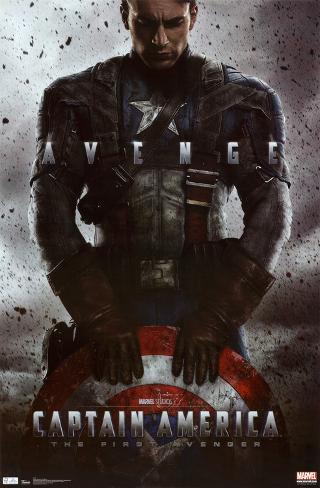
Which was, in my estimation, an excellent movie. In the inevitable competition between Cap and Thor, I believe I prefer the former - though this is largely on account of a general preference for pulpy to cosmic action.
Luckily, Captain America has some fairly substantial pulp roots, being directed by Joe Johnson, who also directed The Rocketeer and won an Oscar for effects work on Raiders of the Lost Ark - the latter, in fact, gets a shout-out from the Red Skull, who criticizes Adolph Hitler's search for "trinkets in the desert" while he has harnessed the power of Asgard.
Yeah, Asgard. One of the numerous things the film did well was tying in the previous films, in a much more overt manner than the blink-and-miss references of previous films. As mentioned, the power source for Red Skull's weird war machines is an artifact from Thor's Asgard - the 'chapel' scene where he first acquires it makes this patently obvious - and his last scene strongly implies that he got swept up into the Bifrost. On the allied side, one of the SSR's scientists is none other than Howard Stark, future father of Tony, and apparently the inventor of a mid-20th-century hovercar.
Indeed, I was greatly impressed with the film's the pulpy super-tech, and the general look of the film - it's probably the first time I have walked out of the theater and thought "Hmm, I wonder if there's an Art of book available yet?" (There is.)
But it takes more than good art direction to make a decent film. Fortunately, Captain America pays as much attention to story and character as it does to spectacle. The focus, of course, is on Steve Rogers - I thought the film did an excellent job of showing how, even pre-serum, he displayed the qualities of bravery (his beating in the alley), intelligence (the flagpole incident), and selflessness (the grenade episode), and how the serum merely allowed him to give full expression to his already noble character, less the relatively short time he spends in the USO (which, though objectively it may have actually been an important contribution to the war effort, was certainly portrayed as Cap not living up to his potential).
Previously, I had mentioned that I thought the preview of the Tesseract at the end of Thor was an odd choice, telegraphing as it did the ending of this film. As it happens, this turned out not to be a big deal, as we see - or at least infer - what happens to Cap at the end of the war, at the beginning of the film. Knowing what's coming, the fate of the Cube isn't nearly as important (and we do see its final acquisition by the proto-S.H.I.E.L.D, in a nice scene that builds both Cap's and Howard Stark's characters, without Cap even being present).
The film proper ends with Cap's introduction to the modern world, in a scene which cunningly mirrors the first few moments after he took the serum. Showing up to explain things is Nick Fury (of course), leading into next spring's Avengers film - which, now that all the principals have been shown, was previewed in a teaser trailer after the credits. Is it May 2012 yet?
Anyway, despite that buildup I think that Captain America works equally well as a stand-alone movie. It's not without its flaws - I was particular bothered by a few scenes in the "battles montage" that screamed "obviously supposed to be in 3-D!!" - but the good parts of the movie more than make up for it.
Sunday, June 12, 2011
A Remembrance For "Raiders"

Thirty years ago today saw the theatrical release of Raiders of the Lost Ark, by most metrics one of the best films ever made. It's certainly one that had a measurable impact on me, even though I didn't actually see it until I was in my teens.
Once I did, however, it quickly became one of my favorite films*. A large part of this, I think is my appreciation for Indiana Jones as a character - he's a much more intellectual character than many similar heroes, and as many encounters with characters played by Pat Roach shows, isn't always (or even often) able to win a fight simply by overpowering his opponent.
Raiders is also a fairly tightly-plotted movie, moving along from scene to scene with just enough explanation to be understandable, without losing momentum.

And boy is there a lot of momentum.
Despite a few mis-steps (in particular, Brody's recounting of the Ark's appearances in the Bible has always seemed a bit exaggerated to me), it's easy to see why this movie is so highly regarded - and I'm sure that thirty more years won't change that at all.
*Although, to be truthful, I slightly prefer Indiana Jones and the Last Crusade. But only slightly.
Tuesday, May 31, 2011
Stranger, Yet Familiar
Way, way back during the previous incarnation of this blog, I posted a bit about the then-current Pirates of the Caribbean film, Dead Man's Chest. Going back and re-reading my excited ramblings is a bit humbling now - possibly my views on that film have since been a bit soured by the failures of At World's End, but in retrospect I seem a bit . . . uncritical (also less skilled with formatting).
Still, having seen the latest installment in the franchise - Pirates of the Caribbean: On Stranger Tides - I can safely say that it was at least as good as DMC, and probably a bit better.
Still, having seen the latest installment in the franchise - Pirates of the Caribbean: On Stranger Tides - I can safely say that it was at least as good as DMC, and probably a bit better.
Saturday, May 21, 2011
Hwæt - Hammer Time!
What was I just saying about the 2011 blockbuster season?
So, two weekends past saw the release of Thor, the latest Marvel superhero film. Despite knowing basically nothing about comic-book Thor, I am at least superficially familiar with Norse mythology, so I hoped I wouldn't be completely lost. Before I get into the more specific yet hopefully spoiler-light commentary on the film itself, however, I do need to note that this was the first feature film I have seen utilizing the latest generation of 3D technology.
I wasn't impressed.
Now, it may be that the theater itself was at fault, but I thought that for a supposedly cutting-edge visual technology, the film was awfully blurry, especially during the early fight scenes. I've heard that other places have had a similar problem, so whether it was a flaw in the filming process, some or all of the prints, or the projection I'm not sure. I do think think that if it worked properly it would have been fairly impressive - but it didn't.
The movie itself, however, I thought was really good. I personally didn't like it quite as much as either Iron Man film - but then, I generally prefer Batman to Superman, too.
As I mentioned, my prior knowledge of Marvel's take on Norse mythology quite scanty (I think limited to the fact that Thor's secret identity was a scrawny doctor named Donald Blake, a reference I did catch when it popped up in the film), but the film was still perfectly easy to follow. I was especially pleased at a few mythological tidbits that made it in, such as a brief appearance by Sleipnir (I hear Hugin and Munin made it in, too, but I didn't catch them), as well as a certain plot-relevant revelation about Loki that I had completely forgotten about.
The conceit that the Norse pantheon is based on interactions with advanced humanoid aliens, while hardly original, was well-presented - especially the notion of Yggdrasil as a kind of wormhole network, which was quite impressively pictured during the ending credits. Some of its briefly-mentioned yet unseen planet-branches make for intriguing sequel possibilities - this long-standing Tolkien fan would really, really like to see Thor visit Alfheim, for example.
Plot-wise, the film didn't make any major mis-steps, although I do think that Thor's character growth should have taken somewhat longer, in-story, than it did. The ending I think played a bit with audience expectations - we know Thor is going to be in The Avengers, so his situation in this film's closing was somewhat surprising. It will be interesting to see how this gets resolved without either overtaking the entire film or trivializing the end of Thor.
The post-credits stinger was also interesting, though I suspect it would have worked a lot better if Thor had been released after Captain America. While I suppose part of the point of the stingers has so far been to lead into the next film; given that Cap's movie is going to be largely a period piece, it still seemed kind of a weird thing to preview.
Speaking of stingers, I was quite impressed with the way the one from Iron Man II was integrated into the plot of Thor, even as they reinterpreted it - the activity buzzing around the crater that we (or at least I) assumed to be SHIELD agents turned out to be a bunch on New Mexican rednecks having a party. And for the record, Stan Lee's cameo as one of said rednecks may be one of his funniest yet.
Of the, hmm, controversial casting of Idris Elba, I'll say no more than that I found his performance entirely appropriate to his character, and that Al Harron of The Blog That Time Forgot has two excellent pieces on the whole affair. Oh, and his sword was created by the previously blogged sword-smiths at Mad Dwarf Workshop - great job there, guys!
One last thing to mention, and that's Loki's character development. In many ways, Loki's story acts as a parallel to his brother's - while Thor starts out with little sense and a huge ego that gets somewhat chopped down to size over the course of the movie -

So, two weekends past saw the release of Thor, the latest Marvel superhero film. Despite knowing basically nothing about comic-book Thor, I am at least superficially familiar with Norse mythology, so I hoped I wouldn't be completely lost. Before I get into the more specific yet hopefully spoiler-light commentary on the film itself, however, I do need to note that this was the first feature film I have seen utilizing the latest generation of 3D technology.
I wasn't impressed.
Now, it may be that the theater itself was at fault, but I thought that for a supposedly cutting-edge visual technology, the film was awfully blurry, especially during the early fight scenes. I've heard that other places have had a similar problem, so whether it was a flaw in the filming process, some or all of the prints, or the projection I'm not sure. I do think think that if it worked properly it would have been fairly impressive - but it didn't.
The movie itself, however, I thought was really good. I personally didn't like it quite as much as either Iron Man film - but then, I generally prefer Batman to Superman, too.
As I mentioned, my prior knowledge of Marvel's take on Norse mythology quite scanty (I think limited to the fact that Thor's secret identity was a scrawny doctor named Donald Blake, a reference I did catch when it popped up in the film), but the film was still perfectly easy to follow. I was especially pleased at a few mythological tidbits that made it in, such as a brief appearance by Sleipnir (I hear Hugin and Munin made it in, too, but I didn't catch them), as well as a certain plot-relevant revelation about Loki that I had completely forgotten about.
The conceit that the Norse pantheon is based on interactions with advanced humanoid aliens, while hardly original, was well-presented - especially the notion of Yggdrasil as a kind of wormhole network, which was quite impressively pictured during the ending credits. Some of its briefly-mentioned yet unseen planet-branches make for intriguing sequel possibilities - this long-standing Tolkien fan would really, really like to see Thor visit Alfheim, for example.
Plot-wise, the film didn't make any major mis-steps, although I do think that Thor's character growth should have taken somewhat longer, in-story, than it did. The ending I think played a bit with audience expectations - we know Thor is going to be in The Avengers, so his situation in this film's closing was somewhat surprising. It will be interesting to see how this gets resolved without either overtaking the entire film or trivializing the end of Thor.
The post-credits stinger was also interesting, though I suspect it would have worked a lot better if Thor had been released after Captain America. While I suppose part of the point of the stingers has so far been to lead into the next film; given that Cap's movie is going to be largely a period piece, it still seemed kind of a weird thing to preview.
Speaking of stingers, I was quite impressed with the way the one from Iron Man II was integrated into the plot of Thor, even as they reinterpreted it - the activity buzzing around the crater that we (or at least I) assumed to be SHIELD agents turned out to be a bunch on New Mexican rednecks having a party. And for the record, Stan Lee's cameo as one of said rednecks may be one of his funniest yet.
Of the, hmm, controversial casting of Idris Elba, I'll say no more than that I found his performance entirely appropriate to his character, and that Al Harron of The Blog That Time Forgot has two excellent pieces on the whole affair. Oh, and his sword was created by the previously blogged sword-smiths at Mad Dwarf Workshop - great job there, guys!
One last thing to mention, and that's Loki's character development. In many ways, Loki's story acts as a parallel to his brother's - while Thor starts out with little sense and a huge ego that gets somewhat chopped down to size over the course of the movie -

With apologies to Marvel and M. C. Hammer.
- Loki becomes less sensible and more ego-driven as events spiral out of his tenuous control. Even so, right up through the end he remains a sympathetic antagonist - even now, it's not so hard to imagine that he and Thor could end up reconciled. I expect they won't, not permanently, but if Thor really takes off as a franchise it would be an unexpected and inspiring direction to take it.
Friday, December 17, 2010
A Left-Handed Complimentary Review
So, this evening I was out with the family at the movies, seeing the latest installment of an ongoing fantasy franchise. No, not that one, we saw The Chronicles of Narnia: The Voyage of the Dawn Treader. As Voyage has always been one of my favorites among C. S. Lewis' Narnian tales, I was rather worried about how it would turn out. The various trailers leading up to the film's release didn't really help my growing sense of unease.
As it happens, my fears were completely justified. The various episodes that make up the tale of the Dawn Treader were for the film, variously abbreviated, combined, shuffled, and forced into an overarching metaplot with no basis in the original book whatsoever. As an adaptation, it was probably one of the worst I've ever seen, second only to Eragon.
And yet . . .
And yet, it's only in the adaptation of the story sequence that I can find any faults in the film. Visually, it's gorgeous, as most movies are these days, with special mention going to the Dawn Treader herself, as well as the Sea Serpent in all its giant-cobra-meets-Venus-flytrap glory. None of the characters were mishandled, as far as I could tell - Eustace's introduction and growth from whiny baggage to protagonist, in particular, was handled quite well, even including his particular friendship with Reepicheep. Aslan, much to my delight, even kept his lines from the end of the film spelling out that He's in our world, too.
There were a surprisingly small number of things that were actually missing from the film, given how violently everything else was rearranged, and most of them I can grudgingly concede as being lost for time constraints (although you'd think that when one meets Ramandu's Daughter on Ramandu's Island, Ramandu himself would at least show up). Even the aforementioned metaplot, as shoehorned in and unnecessary as it was, at least wasn't completely out of left field - maybe I grasp at straws trying to make it better, but the "seven swords on Aslan's table protecting Narnia" thing, to my mind, has a faint echo of the tree Diggory planted at Narnia's genesis in The Magician's Nephew.
Clearly, I have some rather conflicted feelings about the film. Maybe I'm too easily pleased by a decent spectacle, but I'm having a hard time building up any rage against the film-makers for the changes they made to the story. One thing I'm not conflicted about is that when they get around to doing my other favorite Chronicle, The Silver Chair - and there were certainly enough hooks in the ending to assure me that they're planning just that - I'll be ready and willing to set sail for Narnia again.

As it happens, my fears were completely justified. The various episodes that make up the tale of the Dawn Treader were for the film, variously abbreviated, combined, shuffled, and forced into an overarching metaplot with no basis in the original book whatsoever. As an adaptation, it was probably one of the worst I've ever seen, second only to Eragon.
And yet . . .
And yet, it's only in the adaptation of the story sequence that I can find any faults in the film. Visually, it's gorgeous, as most movies are these days, with special mention going to the Dawn Treader herself, as well as the Sea Serpent in all its giant-cobra-meets-Venus-flytrap glory. None of the characters were mishandled, as far as I could tell - Eustace's introduction and growth from whiny baggage to protagonist, in particular, was handled quite well, even including his particular friendship with Reepicheep. Aslan, much to my delight, even kept his lines from the end of the film spelling out that He's in our world, too.
There were a surprisingly small number of things that were actually missing from the film, given how violently everything else was rearranged, and most of them I can grudgingly concede as being lost for time constraints (although you'd think that when one meets Ramandu's Daughter on Ramandu's Island, Ramandu himself would at least show up). Even the aforementioned metaplot, as shoehorned in and unnecessary as it was, at least wasn't completely out of left field - maybe I grasp at straws trying to make it better, but the "seven swords on Aslan's table protecting Narnia" thing, to my mind, has a faint echo of the tree Diggory planted at Narnia's genesis in The Magician's Nephew.
Clearly, I have some rather conflicted feelings about the film. Maybe I'm too easily pleased by a decent spectacle, but I'm having a hard time building up any rage against the film-makers for the changes they made to the story. One thing I'm not conflicted about is that when they get around to doing my other favorite Chronicle, The Silver Chair - and there were certainly enough hooks in the ending to assure me that they're planning just that - I'll be ready and willing to set sail for Narnia again.
Friday, November 05, 2010
Treason & Plot
"Remember, remember,
The Fifth of November,
The Gunpowder Treason and Plot,
I know of no reason
Why the Gunpowder Treason
Ever should be forgot."
The Fifth of November,
The Gunpowder Treason and Plot,
I know of no reason
Why the Gunpowder Treason
Ever should be forgot."
As has been my tradition for the past few years, I celebrated Guy Fawkes Night this year by re-watching the movie V for Vendetta. It's been a favorite of mine since I first saw it in the theater, and its anti-tyranny message has made it very popular in some quarters.
It's interesting, though, that for many of the centuries since the original Guy Fawkes was captured in 1605, he wasn't considered the hero he, as well as his contemporary counterpart V, are today. In fact, the reason that the fifth of November was originally celebrated is because Fawkes failed to blow up "the King and Parliament", as the poem continues. It seems to be a relatively recent shift in celebrating not the failure of the attempt, but the man making it.
However, the perception of Fawkes and V as lone rebels against an unsympathetic government, no matter how romantic, deserves a bit of a closer look. Not only because it's not quite true (Fawkes was only one of about a dozen conspirators, and far from the mastermind at that), but because their actions could be, and have been (and not without some merit) labeled as terrorism. V for Vendetta, of course, makes this explicit - and yet we still sympathize with V over the Norsefire government, because the latter is such an overtly repressive, authoritarian regime.
Guy Fawkes' situation is a little more complex. He was a Catholic in a time and place where that religion was unacceptable, but slowly becoming less so. Too slowly, unfortunately, for the conspirators' tastes, hence the Plot. And yet, the plan to install a Catholic monarch over 17th-century England doesn't exactly mesh with the anti-authoritarian symbol he's become.
And what of the charges of terrorism? "One man's terrorist is another man's freedom fighter" is somewhat trite, but in some situations it may be true. Of course, neither V's actions (if he didn't intended to terrify people, does it count as terrorism?) nor Fawkes' (as I mentioned, religious toleration for Catholics was slowly growing in England right up until he got caught under Parliament with a barrel of gunpowder) truly fit those circumstances.
In the end, I think what really drives the current popularity of Guy Fawkes Night is, again, the idea of one man standing against injustice. In today's world it often seems like individuals can't make a difference, but as a wise man once said, "in every revolution, there's one man with a vision" - and the courageousness (if not the methods) of Guy and V will be there for the inspiration as long as we remember, remember the Fifth of November.
Wednesday, August 25, 2010
My Take on the Cinematic Mystery of the Decade
By which, of course, I mean Inception. People still concerned about spoilers should look away now.
The "mystery" to which I refer, of course, is the spinning top in the final frames of the film, which ends before we see whether it falls - thus implying, supposedly, that Mal might be right, and the film's "reality" is really just another dream.
Personally, I don't buy it. There are a couple of reasons for this: First, the top wobbles. Leaving aside all the speculation and debate about how exactly the totems in general and the top in particular works, the fact remains that the top's purpose to the plot is as a indicator that the protagonists are in "reality", and to subvert that at the last second would completely undercut Cobb's character development arc. No, I think Cobb is in his prime reality, with his real children, and to suggest otherwise (for example that, as one theory I've seen goes, he spends the whole movie trapped in Limbo and the inception heist is "really" Mal and his team trying to rescue him) is to read things into the film that simply aren't there.
However, as a careful reading of that last paragraph will indicate (go ahead and check, I'll wait), that's not quite all that there is to this film. In fact, what I think is really going on here is that Nolan has made a film that is a quite clever metaphor for film-making itself. The key scene for this interpretation is when Cobb and Ariadne begin talking in the cafe - when Cobb points out that they must be in a dream because she can't remember how, exactly, she got to that point, we as the audience take a moment to realize the significance of this. Why? Because skipping transitory elements (like walking to a cafe) is exactly what most films do to keep the pacing from slowing to a crawl.
In a way, then, the reality of the film actually is another dream - but it's not Cobb's dream, it's Nolan's. The next level isn't some hypothetical plane with Cobb's real family, it's the actual real world, where Cobb is played by Leonardo DiCaprio, and little cinematic goof-ups like not having your characters wake up when their van rolls down a hill can be completely overcome by using that opportunity to stage a fight scene in a revolving hallway set.
Finally, one last thought to really break your brain: a great many people actually do believe that there is a level of reality beyond this one, and furthermore that death is the quickest way to jump from here to there (although, of course, purposefully causing your own or someone else's death to jump there faster will likely be frowned upon by the One in charge, but no analogy is perfect).
The "mystery" to which I refer, of course, is the spinning top in the final frames of the film, which ends before we see whether it falls - thus implying, supposedly, that Mal might be right, and the film's "reality" is really just another dream.
Personally, I don't buy it. There are a couple of reasons for this: First, the top wobbles. Leaving aside all the speculation and debate about how exactly the totems in general and the top in particular works, the fact remains that the top's purpose to the plot is as a indicator that the protagonists are in "reality", and to subvert that at the last second would completely undercut Cobb's character development arc. No, I think Cobb is in his prime reality, with his real children, and to suggest otherwise (for example that, as one theory I've seen goes, he spends the whole movie trapped in Limbo and the inception heist is "really" Mal and his team trying to rescue him) is to read things into the film that simply aren't there.
However, as a careful reading of that last paragraph will indicate (go ahead and check, I'll wait), that's not quite all that there is to this film. In fact, what I think is really going on here is that Nolan has made a film that is a quite clever metaphor for film-making itself. The key scene for this interpretation is when Cobb and Ariadne begin talking in the cafe - when Cobb points out that they must be in a dream because she can't remember how, exactly, she got to that point, we as the audience take a moment to realize the significance of this. Why? Because skipping transitory elements (like walking to a cafe) is exactly what most films do to keep the pacing from slowing to a crawl.
In a way, then, the reality of the film actually is another dream - but it's not Cobb's dream, it's Nolan's. The next level isn't some hypothetical plane with Cobb's real family, it's the actual real world, where Cobb is played by Leonardo DiCaprio, and little cinematic goof-ups like not having your characters wake up when their van rolls down a hill can be completely overcome by using that opportunity to stage a fight scene in a revolving hallway set.
Finally, one last thought to really break your brain: a great many people actually do believe that there is a level of reality beyond this one, and furthermore that death is the quickest way to jump from here to there (although, of course, purposefully causing your own or someone else's death to jump there faster will likely be frowned upon by the One in charge, but no analogy is perfect).
Sunday, July 25, 2010
News Tidbits From San Diego
As many of you are likely already aware, this week was the San Diego Comic Con, which, if not the biggest annual geek get-together in the world, is certainly in the running. For obvious reasons, many film studios and other companies take advantage of this concentration of nerdery to make announcements about upcoming projects, several of which I am quite excited about:
"Cowboys and Aliens" footage and image (via io9)
First off, apparently there was footage on display from next summer's sci-fi Western movie, an adaptation of Cowboys and Aliens. Now, a movie about an alien invasion of the Wild West would be amazing enough, but the two main stars? Daniel Craig and Harrison Ford. That pretty much sells it for me. Although the footage itself hasn't leaked onto the 'net yet, we do have this single image of Craig's alien-tech-wielding cowboy:

As if that wasn't enough, it also appears that the director of Cowboys and Aliens is none other than Iron Man franchise director Jon Favreau. In fact, it's rumored that Robert Downey Jr. was slated for Craig's role, before scheduling conflicts forced him to bow out. Which brings us to our next bit of news:
Joss Whedon confirmed as "Avengers" Director (also via io9)
It's been rumored for a while now, but this week was the official announcement. Now, I haven't seen all of the stuff Whedon's famous for, but for all the jokes about The Avengers getting canceled halfway through or suddenly having a petite female fighter character, he's got a pretty good reputation. And the stuff I have seen - mostly Firefly and Dr. Horrible - I've liked, so this is a tentative thumbs-up. Part of me does wonder, though, who we might see as a cameo (like Bruce Campbell does in the Sam Raimi Spiderman films) - Nathan Fillion? Summer Glau? I'll make a Bingo card. And, hey, speaking of Bruce Campbell . . .
Burn Notice Announces Sam Axe Prequel (via TVGuide.com)
And there was much rejoicing.
Is "Pirates of the Caribbean" the Next LEGO License? (via FBTB)
 Given the sudden cancellation of the popular 2009 Pirates line, TLC's acquisition of a general Disney license, the upcoming Pirates of the Caribbean: On Stranger Tides , and this Jack Sparrow minifig in TLC's Comic-Con display . . . I'd say yes. Whether it'll be a good thing remains to be seen, but despite some knee-jerk criticism (the flesh-tone battle is over, people), I'm cautiously optimistic. And this means Stranger Tides is coming next summer, too!
Darth Vader Robs New York Bank (via NYDailyNews.com)
OK, technically this has nothing to do with Comic-Con (save a tangential relationship involving the wearing of sci-fi character costumes), but this one was too amusing to pass up.
"Cowboys and Aliens" footage and image (via io9)
First off, apparently there was footage on display from next summer's sci-fi Western movie, an adaptation of Cowboys and Aliens. Now, a movie about an alien invasion of the Wild West would be amazing enough, but the two main stars? Daniel Craig and Harrison Ford. That pretty much sells it for me. Although the footage itself hasn't leaked onto the 'net yet, we do have this single image of Craig's alien-tech-wielding cowboy:
As if that wasn't enough, it also appears that the director of Cowboys and Aliens is none other than Iron Man franchise director Jon Favreau. In fact, it's rumored that Robert Downey Jr. was slated for Craig's role, before scheduling conflicts forced him to bow out. Which brings us to our next bit of news:
Joss Whedon confirmed as "Avengers" Director (also via io9)
It's been rumored for a while now, but this week was the official announcement. Now, I haven't seen all of the stuff Whedon's famous for, but for all the jokes about The Avengers getting canceled halfway through or suddenly having a petite female fighter character, he's got a pretty good reputation. And the stuff I have seen - mostly Firefly and Dr. Horrible - I've liked, so this is a tentative thumbs-up. Part of me does wonder, though, who we might see as a cameo (like Bruce Campbell does in the Sam Raimi Spiderman films) - Nathan Fillion? Summer Glau? I'll make a Bingo card. And, hey, speaking of Bruce Campbell . . .
Burn Notice Announces Sam Axe Prequel (via TVGuide.com)
And there was much rejoicing.
Is "Pirates of the Caribbean" the Next LEGO License? (via FBTB)
Given the sudden cancellation of the popular 2009 Pirates line, TLC's acquisition of a general Disney license, the upcoming Pirates of the Caribbean: On Stranger Tides , and this Jack Sparrow minifig in TLC's Comic-Con display . . . I'd say yes. Whether it'll be a good thing remains to be seen, but despite some knee-jerk criticism (the flesh-tone battle is over, people), I'm cautiously optimistic. And this means Stranger Tides is coming next summer, too!Darth Vader Robs New York Bank (via NYDailyNews.com)
OK, technically this has nothing to do with Comic-Con (save a tangential relationship involving the wearing of sci-fi character costumes), but this one was too amusing to pass up.
Thursday, June 24, 2010
On Second Thought . . .
Due to seeing The A-Team, again last night, I have to conclude that I might have been a little harsh in my criticism of Faceman's writers. There was, in fact, an instance (during the preparation for the Baghdad Job) when he used trickery and impersonation to gather equipment for the team. There were also indications, such as our brief glimpse of his time in prison, that he does this regularly off-screen. I do, however, stand by my assertion that there should have been more focus on this, and less on him learning to mimic Hannibal's planning style.
Also, I spotted what may be an undiscussed Easter Egg - during the brief shot of Hannibal's toe-tag, the other name (besides, "John H. Smith") reads, "Dr. Schultz". Is this another reference to original Murdock actor Dwight Schultz? If so, it's a bit odd, since Murdock has nothing to do with that particular scene.
Also, I spotted what may be an undiscussed Easter Egg - during the brief shot of Hannibal's toe-tag, the other name (besides, "John H. Smith") reads, "Dr. Schultz". Is this another reference to original Murdock actor Dwight Schultz? If so, it's a bit odd, since Murdock has nothing to do with that particular scene.
Subscribe to:
Posts (Atom)


 Posts
Posts

