Showing posts with label book. Show all posts

Monday, March 28, 2022

BREAKING: New Conan the Barbarian Novel by . . .

. . . noted Alternate History author S. M. Stirling?

Yes, it's true, at least according to a press release published last Thursday (March 24) by Conan.com. The rest of the press release is short on details, but does reveal that the novel - Conan: Blood of the Serpent - will serve as a prequel to the classic Conan adventure Red Nails - a personal favorite of mine due to its opening featuring Conan battling a stegosaurus.

Art by Alex Horley

It's not the worst place to slot a pastiche story - I'm not up on the ins and outs of the post-Howard novels, though I have read a few, so I couldn't say if this is going to conflict with anything written previously. I feel confident in predicting that Valeria of the Red Brotherhood will appear if not have a prominent role, since she appears in Red Nails and is well, a woman rather like Conan himself.

A few pertinent details about the novel can be gleaned from the Amazon page, including the October 18 release date, price and page-count. This last number, 496 pages, is slightly worrying - Conan as conceived by Robert E. Howard was the hero of short, tightly written novellas and short stories. Even advertised as a standalone, the page-count of a modern doorstopper stands in sharp contrast. That's not to say it can't still be the pulpy adventure Conan deserves, but much depends on the writer.

So, S. M. Stirling. Not the first name that comes to mind for Conan, but given the requirement for a certain level of name recognition I can think of several worse ones. I can also see the potential - as mentioned, he's primarily an alternate history author, but his most famous series takes place in the sort of sword-swinging milieus that resemble the Hyborian Age in reasonable facsimile. And at his best, his novels do echo the pulpy action that Robert E. Howard excelled at - I've even heard that Howard himself appears in a short story set in the world of Stirling's The Peshawar LancersAt his worst - well, there's no need to dwell on potential disasters until we have more news. Sucess or failure, we'll know in the fall.

A big thank you to the DMR Books blog and their weekly DMRtian Chronicles posts for bringing this piece of news to my attention.

Thursday, April 30, 2020

The Shadowcast Knows

Who knows what evil lurks in the hearts of men?

Pulp enthusiasts of all descriptions will recognized the introductory catchphrase of The Shadow, dark vigilante and superhero precursor. Indeed, although it's been ninety years since the first appearance of the character, he still has a loyal following. One example of this is the excellent, if irregular, Shadowcast, whose fifth episode earlier today was a welcome surprise:


Ostensibly covering the first appearance in The Shadow (and indeed anywhere) of a supervillan, host RazorFist covers a wide spectrum of Shadow lore. I was particularly interested in his discussion of how The Shadow's primary author, Walter B. Gibson, apparently had an elaborate filing system that he used to control continuity, thus enabling the Shadows intricate cast of recurring characters. Also of note was the description of the way Gibson used his background as a stage magician to inform his writing, particularly in the climax of the story under discussion, The Voodoo Master.

For those who are less familiar with The Shadow in general, or have hitherto been unaware of this podcast, I encourage you to start at the beginning and enjoy a celebration of an iconic hero by a knowledgeable and entertaining critic - even without his customary use of, shall we say, "colorful metaphors".


Saturday, March 21, 2020

Free Books For Your Quarantine Downtime

Whether from voluntary social distancing or official shelter-in-place orders, many of us are currently finding ourselves with more time on our hands than we're used to (others, of course, are in the medical field or grocery industry and working overtime to meet the current crisis, and I for one offer my sincerest thanks). Some of us, no doubt, are taking the opportunity to attack our tsundoku, but just in case anyone is in danger of running out of things to read, many authors are stepping up to fill the gap - at no charge.

The most prominent, at least in my Internet circles, is Corona-Chan: Spreading the Love, an anthology assembled in just a few days by David V. Stewart and many, many authors of the Pulp Revolution. I've talked about some of them on this blog before - Jon Mollison, for example, has donated his entire novel Adventure Constant, which I reviewed a few years ago and still recommend wholeheartedly. Other contributors include Justified's Jon Del Arroz and former and current Geek Gab hosts Brian Niemeier and Daddy Warpig. They are joined by a host of other independent authors, many of which have appeared in various issues of Cirsova magazine. And speaking of Geek Gab, their most recent episode has as guests contributors John Daker and Yakov Merkin:


If you prefer something a little more mainstream, gonzo techno-thriller writer Jeremy Robinson is offering a five-book package on his website, with a sixth offered for joining his mailing list. Now, I haven't read a great deal of Robinson, but what I have has kept me interested. Of the books in his bundle, I'm particularly interested in Flux, which sounds like it shares some premises with Eric Flint's Time Spike or 1632. The latter of these also happens to be free, from Amazon or Baen Books directly, although it's been so since long before the Wuhan Flu made its presence known. Come to think of it, the Baen Free Library is another great source in general for free things to read, including one of my perennial favorites - Larry Correia's Monster Hunter International.

To conclude, I'd like to thank all the authors mentioned above for their generosity in making their work available to the reading public during this crisis. Now let's do our part by keeping our hands clean and giving the coronavirus no chance to spread.

Sunday, November 17, 2019

Introducing the Inklings Literary Crossover Universe

This past April Fool's Day, C. S. Lewis fansite NarniaFans.com posted an article claiming that the Tolkien biopic would feature a post-credits cameo of Lewis, thus setting up the "Inklings Cinematic Universe". While an amusing reference to 2008's Iron Man and the franchise it spawned, in the absence of the scheduled-for-this-month Lewis film (starring current Spider-Man Tom Holland in the title role!), it occurred to me that the Inklings, or at least Lewis and J.R.R. Tolkien, had put enough shout-outs and shared concepts into their work to form a little universe of their own.

Art by Afalstein
The linchpin of this Inklings Literary Crossover Universe, or ILCU, is Tolkien's unfinished 1945 novel The Notion Club Papers. In this story, an ersatz version of the Inklings discuss science fiction and experiment with astral projection, culminating in an echo of the sinking of Atlantis manifesting in the modern Atlantic. Now, there's a good deal more going on in the story than that - it's a very experimental piece of writing in many ways, quite distinct from Tolkien's usual neomythic mode - but for ILCU purposes there's two things to focus on. First is that Tolkien uses in the story his own version of Atlantis, or more properly NĂºmenor, that sits in the background of The Lord of the Rings as the homeland of Aragorn's ancestors. This fits with Tolkien's idea that Middle-Earth is the mythic past of our own world.

The other thing to note about The Notion Club Papers is that one of the works discussed early on is Out of the Silent Planet, the first book in C. S. Lewis' Cosmic Trilogy. What makes this interesting from a crossover world-building perspective is that Out of the Silent Planet ends with a conversation between the protagonist Elwin Ransom (in many ways a fictionalized Tolkien) and the un-named narrator (implicitly Lewis himself) discussing how they were going to publish an account of the story marketed as fiction. So, we can assume that the world of the Notion Club's psychic voyages is the same as Dr. Ransom's physical ones, and both are the far future of Middle-Earth. The last Cosmic Trilogy book, That Hideous Strength, also talks about Atlantis as "Numinor", strengthening the connection.

Another connection to the Cosmic Trilogy that only recently came to my attention is the result of the academic work of Brenton Dickieson, who in a 2016 blog post described his discovery of a hitherto unknown draft preface to The Screwtape Letters which attributed the acquisition and translation of the letters as being from none other than Dr. Elwin Ransom. As the following chart shows, Screwtape was written after Out of the Silent Planet but before its two true sequels (there's also the whole issue of the controversial The Dark Tower, which I have yet to read):


Now, this definitely shows that Lewis made a couple of false starts in developing the sequel to Out of the Silent Planet, and the extent to which he still considered Screwtape to be connected is an open question. Personally, I can think of a couple of episodes in Screwtape that support the connective interpretation, such as the incident where Screwtape "inadvertently assumes the form of a large centipede", similar to the end of the fight between Ransom and the Un-Man in Perelandra. And frankly, the idea of Wormwood and Screwtape as bent Eldila toiling away under the fallen Oyarsa Melkor is, to me at least, a pleasingly coherent one.

One final thought for this post, and that's how Lewis' claim to fame, The Chronicles of Narnia, might be brought into the ILCU. Unfortunately there is not, to my immediate recollection, a direct textual link between the Chronicles and the other works of the various Inklings. The penultimate book in the series, The Magician's Nephew, offers a few thematic links, such as a mention of Atlantis (not Numenor, this time), and the image shared with Tolkien's work of the universe being sung into existence. There are references to Sherlock Holmes and the Bastable children, which were used by Win Scott Eckert in his Crossovers series to fit the Chronicles into his post-Farmer Wold Newton work (a context in which I've mentioned The Notion Club Papers before), but a direct Inklings-only connection will require additional research.

Friday, October 25, 2019

A Tale of Two Conans

When Conan of Cimmeria, Robert E. Howard's iconic sword-and-sorcery hero, was first being adapted to American comic books in the 1970s, the publisher - Marvel Comics, home of Spider-man, the Avengers, and a bright destiny in the movie industry - gave him a starring role in two separate magazines. The first, Conan the Barbarian, was the mainstream, all-ages title while Savage Sword of Conan was meant to be a more adult, sophisticated title. Nearly fifty years later, the Wheel of Copyright has once again brought Conan to Marvel, and while they seem to have a fairly aggressive schedule planned, the central focus is again those two titles.

Conan the Barbarian: The Life and Death of Conan Book One is the first trade collection of the former, although its family-friendliness seems suspect when practically the first time we see Conan he's in a fighting pit in the Maul decapitating his two opponents. Readers familiar with Conan may remember the Maul as being a district in the city The Tower of the Elephant took place in, and indeed the stories that make up this collection have something of a "Conan's Greatest Hits" feel to them. The stories that follow, although there's a continuing story-line with an undead witch and her creepy child minions, jump around to some of the most well-known episodes of Conan's life - one takes place immediately following Beyond the Black River, one while Conan is a pirate, another while he's king, and so on. While the stories are mostly well done, a couple of places (such as the appearance of a sharktopus) get a bit campy - the idea of King Conan and his pet lion becoming a masked vigilante in the Aquilonian capital was so ridiculous it had to have come from corporate meddling. There were some nice shout-outs to the greater Conan continuity, although this was matched by at least one timeline flub (the chapter that takes place after Beyond the Black River ends with Conan going back across the river to civilization, while in the original stories he fights his way through the wilderness to the coast and gets caught up in the plot of The Black Stranger). I also noticed a general trend, common in Conan pastiche, of giving Conan's life an air of Destiny, with everything bending towards his becoming a king. This was something that Howard managed to avoid, even though Conan was already king in his first appearance, and all the earlier stories were technically prequels.

Far less epic in scope, Savage Sword of Conan: The Cult of Koga Thun manages to seem much more complete as a story, although this is probably an unfair comparison to make with something explicitly labeled Book One. Following the well-trodden formula of Conan escaping from dire circumstances that would kill a lessor man, getting mixed up in a struggle over a fabulous treasure, and escaping into the night as everything collapses into chaos; it still manages to insert a few interesting wrinkles, such as the nature of the treasure and the involvement of the mysterious serpent-men, who are usually a Kull thing but always fun to see show up (indeed, of the various scheduled appearance of Conan tying him to the greater Marvel universe, the one I'm most interested in has the intriguing title of Conan: Serpent War). The use of magic in the story seemed heavy compared to the original Howard, what with the undead hordes and the poison that turns humans into serpent-men and the map that imprints itself onto Conan's mind, but the Cimmerian was at least properly suspicious of all of it.

In the end, although they were trying to do quite different things with the pulp-era character, both of these comics presented reasonably enjoyable takes on Conan the Barbarian. It goes without saying that the prose originals by Robert E. Howard were the best, but  once you've read all those, these make as good a continuation as you're likely to find. I did hear that the original single issues that these editions collect had a prose Conan serial in them too, and was a bit disappointed that they weren't also collected. Hopefully they'll turn up in a collection of their own at some point.

Thursday, September 05, 2019

Warriors of the Space Crusade

Picture, if you will, a crusading knight. Struck by a sudden war-weariness, he abandons the fight against the infidel and wanders into the desert, finding himself in an enemy-controlled city. There he wrestles with his newfound pacifistic desire while at the same time freeing and converting enough of the enslaved populace to kick off a full-blown revolt.

A mid-20th-century Technicolor epic? A serial novel from some long-lost historical pulp magazine? In fact, this is the general plot of Justified: The Saga of the Nano Templar, the latest novel from the most electrifying Hispanic in science fiction, Jon Del Arroz. Mixing the rather obvious historical allegory with familiar Mil-SF tropes like power armor and space navies, what comes out is a satisfying tale of equal parts derring-do and Christian philosophizing.

Yes, Christian, for despite the book seeming to take place in a galaxy far, far away with no humans whatsoever in it (although as far as I could tell Templar Drin's enemies, the Sekarans, receive no physical description that differentiates them from humans), the religion of the Elorians is basically Christianity. There are, naturally, some altered details - it's oddly Narnian in that respect - but close enough that the tension between "loving your enemy" and "protecting the innocent" echoes all too strongly with the sympathetic reader.

That tension being the main internal conflict for our Nano Templar means that he remains a very static character throughout. This provides an interesting contrast with the book's other viewpoint character, Anais, who goes from leporine party brat to defiant harem slave to revolutionary guerrilla. The nascent romance between her and Drin was, I thought, one of the book's few weak points, as it bounced hard against the Templar's vows of chastity and generally got lost in the more general swirl of Drin's search for meaning and divine goodwill. As for whether he finds it, well, I think the title of the book is a big clue here.

I received a free copy of this book from the publisher in exchange for this honest review.

Sunday, July 21, 2019

Read Old Stories

A wizard's tower with a captured extra-terrestrial. A murder-by-arson with a shocking twist. A robotic policeman. A mountain from which no-one has returned. An eerie painting that menaces its owner. A swashbuckling stagecoach robber. An underground boxing match in an exotic port.

What do all these elements have in common? They're all from classic stories from a bunch of different genres that I've recently read thanks to the Pulp Classics Reading Club. Brainchild of author David Eyk, this free weekly email delivers stories from some of the best authors of the early 20th century - the likes of Robert E. Howard, Dashiell Hammett, Harry Harrison, Manly Wade Wellman, Max Brand, and Lord Dunsany. What inspired Eyk to such a project? In his own words:

In the erudite and cultured Wisdom of the Current Year, it is an accepted posture to scoff at “escapist literature”: it’s alright to read it if you’re twelve.
But the Wisdom of the Ages tells us something different: a certain form of story nourishes and nurtures our psyches. Especially in hard times, we fall back on the stories closest to our hearts for encouragement and, yes, escape.

If this sounds like something you'd like to get in on, I encourage you to sign up for the Pulp Classics Reading Club here. And if you want to read the stories I alluded to above? Check below the jump.

Sunday, December 23, 2018

Three Hearts, Three Lions, Two Wizards

Recently I've been reading Three Hearts and Three Lions by Poul Anderson, which is about a man fighting in World War II who discovers he has another life as a famous knight in a world that resembles the chivalric romances of King Arthur and similar tales.

It's an enjoyable read, and a fascinating work for any number of reasons - the both implicit and explicit Christianity, the clear antecedents for some elements of fantasy role-playing games (I believe Jeffro addressed this in Appendix N), the way the main character uses his modern knowledge to survive some of the more fantastic elements - although this last, I thought, was somewhat overused and undercut my belief in the setting, to an extent. The rationalization of the giant's cursed gold as being irradiated by the process of turning to stone was an especially bad example.

But the one element that really made me take notice was in Chapter 15, when the knight and his companions visit a wizard to see about getting the knight back to his home world. Said wizard has a sign on his house that reads:

MARTINUS TRISMEGISTUS
Master Magici
Spells, Charms, Prophecies, Healing, Love Potions
Blessings, Curses, Ever-Filled Purses
Special rates for parties

It's not, I think, intended to be entirely serious, and indeed the wizard in question admits that some of the services are for advertising only. However, it brought to mind another advertisement by a wizard some half a century later:

Lost Items Found, Paranormal Investigations
Consulting, Advice, Reasonable Rates
No Love Potions, Endless Purses, Parties, or Other
Entertainment

Now, I've checked the Word of Jim website and have seen no definitive proof of this, but I cannot believe that Harry's ad isn't a response to Martinus'. Not just the format, but especially that last line seems to set up a deliberate dichotomy between the two.

 Whether this specific influence is intended, unconscious, or imagined, I would say that both The Dresden Files and Three Hearts and Three Lions are worth reading. Indeed, as a standalone work the latter is in some ways, despite being originally published in 1953, more accessible.

Sunday, May 27, 2018

Meet the New Doc, Same as the Old Doc

Most of the time, out there in the wilds of the Internetz, coming across something completely flabbergasting is a negative experience. About a week ago, however, I came across something that was definitely positive, if still flabbergasting.

Over at the Castalia House blog, one of their periodic posts highlighting recent releases in Indie and small-press adventure fiction caught my eye with a header mentioning the Man of Bronze, a pseudonym of the classic adventure pulp science-hero and superhero precursor Doc Savage. Now, on previous occasions Castalia House has highlighted the release of the new Doc Savage stories being produced by Will Murray and Altus Press, but this case turned out to be far more interesting.

Except for this one, which is replaced with
the Dynamite comic adaptation cover.
In fact, somebody has released about a dozen of the original Doc Savage pulp stories as Kindle e-books, for about $3.50 a pop. The publisher is listed only as "Amazon Digital Services", and the text appears to be taken from the original 1930s - '40s magazines (complete with introductory illustrations), though the covers are the classic James Bama pieces from the Bantam paperback editions of the '60s - '70s.

With the sole exception of Doc's introductory adventure seen here, none of the specific titles are ones that I'm familiar with. On the strength of The Man of Bronze, however, I'm perfectly willing to recommend them to anyone interested in stories of adventure and heroics.

However, I'm still curious as to how exactly this cornucopia came to be. I'm pretty sure that Doc is not yet in the U.S. public domain (Steamboat Willie is older), yet besides the Castalia House piece I can't find any other references to them. They're not from Altus or the Radio Archives people, as far as I can tell, and I'm not sure who would own the copyright on them anyway. Conde Nast? The price seems way too reasonable to have been set by any major publisher. Maybe it's a stealth marketing campaign for the rumored upcoming Doc Savage movie starring Dwayne "The Rock" Johnson.

CAN YOU SMELL WHAT THE DOC IS COOKING?!
In any event, whether the rest of the 100+ Doc Savage stories are going to be hitting Amazon shortly, or whether these are actually pirated editions that will shortly be yanked, this is a great low-investment way to check out the original tales of a key figure in the history of pop culture.

Saturday, March 03, 2018

The Pulp Revolutionary Sci-Fi of Jon Mollison

OK, now that I've given author Jon Mollison grief a couple of times over the cover of his novel Sudden Rescue, I probably ought to mention that it's really a pretty good book. In fact, last summer was something of a breakout season for Jon, and so far I've picked up three of his novels and thought them all great reads.

I still say he looks like Luigi.
Sudden Rescue, released just under a year ago, starts with an archetype we're all very familiar with, the independent space hauler who's not afraid to shade the finer points of smuggling law. Captain E. Z. Sudden would be right at home with the likes of Han Solo and Malcolm Reynolds, dodging space pirates and overbearing AI empires until he is suddenly thrust into galactic politics with the recovery of some lost cargo containers, one of which contains a member of the local space nobility named Karenina. When it is revealed that she was on her way to a wedding that could make or break the human alliance against the aforementioned AI, she and Sudden must embark on a journey through treacherous peril and exotic, imaginative locations to stop a terrible war.

The next novel, and probably my favorite of the three, is Adventure Constant. This one uses travel to parallel dimensions rather than space, postulating a world where the physical laws of the universe encourage swashbuckling and derring-do. I suspect Jon especially enjoyed the world-building on this one, what with the Panama Canal becoming a lizardman-infested suicide run, Hawaii still an independent kingdom, and the US equivalent run by an office called the Autocrat of Liberty, the current holder of which is described as a "bombastic business tycoon who had rallied the common man to his cause and was even now attempting to roust the cancerous elitists and their foot soldiers from the country." OK, that last one probably didn't take much imagination.

As a crossover enthusiast, I also need to mention the couple of times that Jack Dashing, the hero from our world transported via crashing rocket to this new one, makes a literary reference only to discover that he's accidentally talking about real people. When this happens to the Three Musketeers it's kind of understandable, since half the characters in that work were real people anyway, but when Jack mouths off to a British spy about his 00 number, he barely manages to get the words "secret agent named James -" out before the spy is question goes from demanding where he heard that to ranting about fraudulent poster boys.

With his next release, Jon Mollison returns to the stars with the aptly named Space Princess. In this case, however, the princess is an infant, rescued by a fairly standard American Catholic family and caught up in the political intrigue and space combat that naturally follows. Jon does a neat trick here by making a setting that shares some broad similarities with that of Sudden Rescue - both are interstellar monarchies - but is quite individual at the same time. In fact it reminds me a bit of a lighter and softer Warhammer 40,000, what with all the cathedral- and chapel-shaped ships being used by the Space Catholics (the red crescent fighters and minaret-bedecked capital ships of the Holy Terra-threatening enemy weren't terribly subtle, either). But the best part is the way in which the ordinary family rises to their very un-ordinary circumstances.

In a way, (and given a flexible definition of "ordinary") that's something that all three of these works have in common. In addition, of course, to being fun, adventure-filled works that rest on sound Christian principles without being preachy. The heroes are all heroic, in every sense of the world, and their sense of optimism makes a fine alternative to the too often nihilistic spirit present in many SF works today.

Saturday, January 13, 2018

Deuterocanonical Dresden

One of my blogging goals for 2018 is to revisit and hopefully cap off some of the series of posts that have been left hanging in previous years. Of these, the most egregious is my planned re-read of the Dresden Files series by Jim Butcher, which spluttered out before I even got to the first novel. There are now fifteen novels in the series, along with the various short prose and comic-book stories, and while the release date for the sixteenth has not yet been announced, this summer will see the release of the second short story collection, Brief Cases. Whatever the real-life circumstances that have delayed Harry's adventures, at least we know Jim hasn't lost his touch in coming up with snappy titles.

But all of that is in the future - today, I'd like to highlight a neat resource for Dresden fans that has recently come online. This website is called Word of Jim, and is a compilation of forum postings, live interview responses, comments left on Amazon reviews, and other such ephemera made by Jim Butcher himself that drop hints at future books and explain or undercut various explanations for ongoing mysteries, or just wacky fan ideas. It's great fun to browse through, although I have yet to locate the place where he says that Ronald Reuel, the titular Summer Knight of Summer Knight, is not the same guy as J. R. R. Tolkien. However, another tidbit seems to support my theory that he is:

I’m sure it’s just one of those freaky coincidences. Tweed-clad old smiling ‘creator of worlds of imagination’ Ronald Reuel, Summer Knight of the Seelie Court does not look a thing like Tolkein.

Or, uh. Well he does, yeah.

On advice of legal council, I claim the right of the fifth amendment not to testify against myself…
On the other hand his statements that Justin DuMorne, Harry's guardian, was absolutely, no-questions, "D-E-D dead" (which I take as evidence that Harry's mentor is still alive*) are available, although I had a bit of trouble finding them since I was initially using "DuMorne" as my search term. Truth be told, some of the pages could use a bit of subdivision.

As we mostly-patiently wait for Brief Cases, as well as the next two novels, Peace Talks and Mirror, Mirror (which will be about exactly what you're thinking), I anticipate that Word of Jim will become a well-used resource by the Dresden fan community, and I thank the compiler "Serack the WoJ Guru" for his efforts.


*OK, here goes. Some years before gaining guardianship of the young Harry Dresden, Justin DuMorne was, by all accounts, an exemplary Warden (The Dresden Files' version of a wizardly police officer), who was involved in the takedown of a dangerous necromancer named Kemmler. Immediately after Kemmler's seemingly final demise, however, he absconded with a dangerous artifact (the yet-unnamed Bob the Skull) and, later, trained Harry as a wizard without any of the usual ethical instruction. Later Harry encounters a bunch of Kemmler's old hangers-on, including one with the charming nickname "Corpsetaker", who specializes in tactical body-swapping.

My theory, then, is that during that last battle Justin DuMorne was the victim of a similar body-swap initiated by Kemmler, and thus was killed in the necromancer's body while his own identity was stolen by Kemmler. Thus, DuMorne is, as Jim points out, as dead as Kemmler, in that they both half are and half aren't. Of course, if Jim never brings Kemmler back to face Harry again they might just as well be all dead, but at this point in Harry's career a legendary necromancer with the face of his hated guardian is just the sort of enemy he might encounter. And I have my suspicions about the mysterious figure called Cowl . . .


Friday, July 07, 2017

The Age of the Orc

. . . is often coming, but never quite seems to get here. Scott Oden's new historical fantasy novel A Gathering of Ravens, however, brings it as close as it's ever been.

While this is not the first time that Oden has tackled writing from the orcish point of view - the short story "Amarante" in Skelos II is another example - it's certainly the most ambitious. The story follows Grimnir, who is definitely an orc even if the word is never used (the neologism kaunr is used for Grimnir to describe himself, while other cultures use skraelingr, orcneas, or fomoraig) - murderous, crude, and bloodthirsty. After kidnapping an incredulous Christian traveler as a guide, he sets off from his lair in 10th-Century Denmark in search of the Dane that killed his brother, Grendel.

Well, almost. The brother's name is actually Hrungnir and his killer's Bjarki (a name that, like Beowulf, means bear), but the parallels are undeniable - Hrungnir's arm being displayed along with his head is just one of the more obvious. I was delighted to note there were even shout-outs to more modern versions of the story - at one a Dane begins reciting the famous poem from the film The Thirteenth Warrior ("Lo, there do I see my father . . . "), and certain spoilery facts of Bjarki Half-Dane's backstory are somewhat reminiscent of the 2007 Beowulf film.

Another appearance of the White Tree.
But Beowulf isn't the only piece of meat in this literary stew. There's some Tolkien, of course - a tale about an orc could hardly avoid him - but it's surprisingly superficial. There's a scene with some dwarves (taller than Grimnir!), one of whom is named Nori; and there's a section with a willow-spirit who, in addition to acting like close kin of Old Man Willow, uses heraldry described similar to Gondor's.

In terms of overall style and theme, though, A Gathering of Ravens owes much more to Robert E. Howard than to J. R. R. Tolkien - not just little things like the dog named Conan and the Viking that swears by Crom, but the way the cosmic conflict between paganism and Christianity (not for nothing, I think, is the Battle of Clontarf the climax of the book) forms the background of a personal revenge story, in which the actors shake out in some surprising directions. Not to mention the action and combat scenes, which richly evokes the hard-scrabble life-or-death struggles such events would have been.

Overall, as someone with both an interest in fantasy fiction and medieval history this book was a joy to read - it's obvious the author is well-read on both the historical and mythical background of Viking-age Europe. I have heard that Scott Oden intends to pen more adventures of Grimnir the Last Orc, and can only say the sooner the better.

Favorite line: "This was no game of thrones where generals sacrificed and maneuvered on the backs of their soldiers; this was the most primal sort of conflict - Odin's weather, the red chaos of slaughter - where men stood breast-to-breast and shield-to-shield, and dealt the same blows they took in kind."

I see what you did there!

Sunday, May 28, 2017

Is S.M.Stirling's Emberverse Inspired By John Norman's Gor Series?

A few months back I talked about a podcast called Geek Gab, mentioning that I wasn't a regular listener, but was interested because they were interviewing Jeffro Johnson about his "Appendix N" book. Since then, however, I've been tuning in more often than not, even as they've grown from a single weekly show to a veritable online network.

In one recent episode of the spinoff show Geek Gab Game Night, the guest, game designer Jim Desborough, was talking about his adaption to tabletop gaming of the Gor novels by John Norman. Now, I'm only familiar with this series through it's rather dubious reputation, but the podcast covered most of the non-dubious basics - Gor is a planet in Earth's orbit (only on the opposite side of the sun so it can't be detected from Earth), which has been seeded by inscrutable aliens with small populations of various Earth cultures spirited away and kept from progressing to far down certain areas of technological development, notably firearms.

In the course of the discussion, a brief mention was made of S. M. Stirling's time-traveling Nantucket trilogy that began with Island in the Sea of Time, which got me thinking about the spin-off series that Stirling started with Dies the Fire. That book begins with a catastrophe similar to a worldwide EMP pulse that also depowers gunpowder, somehow. As the books go on, there's a recurring theme - calling it a subplot would be giving it too much credit - of people studying what they call the Change and concluding that, scientifically, it makes absolutely no sense. Eventually it is revealed that, like on Gor, humanity is being artificially kept in its Medieval Stasis by inscrutable aliens*, albeit ones considerably less flashy than the ones on Gor.

Even more intriguingly, the setting has gone through a number of time-skips and is now a couple of generations from the Change. One of the more interesting aspects, as the character's horizons expand, is that they keep meeting different groups of people who've survived psychologically by taking a shared element - say, the RCMP or the Boy Scouts - and making it the foundation of a new culture. This tends to give the map, at least in North America, a sort of anachronistic crazy-quilt feel, much like the descriptions of Gor with its chronologically diverse groups of alien-abducted Earth people.

So was Stirling intentionally riffing on these elements of the Gor setting? I don't know of any concrete evidence one way or another, but I do suspect it to be an unconscious influence. Of course, it could also be a coincidence** that the main villain of the first few books is named Norman, and has a bit of the, shall we say, Gorean philosopher about him . . .

*Actually an inscrutable far-future human gestalt super-mind, or something.

**More certainly a coincidence, and certainly more of a stretch, is the appearance of an ersatz Tarzan in one of the stories in the universe-opening short story collection Stirling edited a few years back. Tarzan, of course, was an invention of Edgar Rice Burroughs along with John Carter, whose Barsoomian adventures the first few Gor books are said to be a New Wave-ish pastiche of.

Sunday, February 26, 2017

SF&F History Month - From Amber to Avalon

Well, we've had some schedule slippage, which I apologize for, but I have a semi - decent excuse in that some personal life changes meant I was without ready Internet access for some of the last month. On the plus side, I was able to finish both Nine Princes in Amber and its first sequel, The Guns of Avalon. Before I get to my thoughts on them, however, I wanted to highlight a bit of (less than hot-off-the-presses) relevant news - The Chronicles of Amber appears to be in production as a television series.

As neat as it would be to see, the most interesting thing about the press release is the many comparisons to Game of Thrones, especially the ones that claim the Amber was an inspiration for Westros. Now, I have yet to read any of the books and have only seen a little of the show, but I can definitely understand where such comparisons come from, given all that happens in Amber in these relatively short books.

(Spoilers Ahead:)

Saturday, December 10, 2016

SF&F History Month - Amber Remembered

At the end of my musings on the first few chapters of Nine Princes in Amber last week, I opined that much of the setting, or at least enough to get a handle on, would soon be explained. As we shall see, I was more or less correct.

As I suspected, Corwin's memory was soon to be returned, but not without a good bit of effort. After meeting up with one of his many brothers and discreetly dealing with the pursuers thereof, the two decide to make the journey to Amber. In a situation not unlike the Pevensies hearing the word "Aslan" for the first time, the word "Amber" conjures up in Corwin a host of associations - he doesn't know what it means, only that he belongs there.


The journey itself is an interesting affair, consisting of what seems to be a number of jumps between alternate universes. Random, the brother, is controlling it somehow, and the travelers' effects change somewhat along with the surroundings (at one point Corwin pulls a bunch of paper currency labeled in Latin out of his wallet), although he isn't able to route them around all the obstacles, including a chase scene with another brother - this one a knight with a pack of especially ferocious hunting dogs.

Corwin takes all this in stride despite his lack of memory, which he eventually confesses to Random. Happily, a solution is offered - a powerful labyrinth called the Pattern that, when navigated by a member of their family, gives their various powers and should restore Corwin's memory. Of course his labyrinth is in Amber itself, but luckily there's a duplicate located at the bottom of a nearby ocean.

Of course it works and Corwin remembers not only his activities for the past several centuries, but the true nature of Amber - ". . . the greatest city that had ever existed or ever would exist. Amber had always been and would always be, and every other city everywhere, every other city that existed was but a reflection of a shadow of some phase of Amber." Heady stuff, and an interesting reversal of the usual assumption that our Earth is the "real" one. It's also, come to think of it, again not unlike the situation in Narnia, where the world the bulk of the stories take place in turns out to be a transient copy of somewhere more real.

Unfortunately for Corwin, however, now that he remembers what Amber is he also remembers that yet another brother - this one a particular rival - is poised to take control of it. Whether Corwin succeeds in stopping him, however, will have to wait for another week.

Saturday, December 03, 2016

The Return of SF&F History Month - Zelazny Style!

So a few years back I tried to boost the idea of December as "Science Fiction and Fantasy History Month". It didn't take off, for various reasons - not the least of which is my own sporadic blogging schedule - but I've always sort of wanted to return to it. With the changes that have happened in the literary SF&F fan-world over the past couple years, this may be the perfect time to reboot it, so for today and the next few Saturdays, I'll be talking about what I hope turns out to be a few different classics.

2017 Fitness Goal: Be able to dress like this guy.
First off is Nine Princes in Amber, the first book in the "Chronicles of Amber" series by Roger Zelazny. I picked this one for a few reasons - I've seen it mentioned on a few lists of important and influential works (it is, for example, covered in Jeffro Johnson's seminal Appendix N series), I'm a big fan of Zelazny's A Night in the Lonesome October, and I suspect it's a big influence on one of my current favorite authors, John C. Wright. Perhaps most influentially, I recently came across a handsome two-volume omnibus collection of the series at my local library. This magnificent cover art by Boris Vallejo merely sealed the deal.

A few chapters in, I'm already thinking I made the right choice. It actually starts much like a contemporary thriller, with a first-person protagonist waking up with amnesia in what appears to be a private clinic. His escape from confinement and initial moves to discover his identity by tracking down the sister that had him confined there could come right out of a (70s-era) Bourne movie, with only a few hints - like his prodigious strength - that something weirder is going on. Even after he finds his sister's set of custom Tarot cards covered in pictures of what he recognizes as his family in archaic dress, it might just all be part of a weird but ultimately mundane conspiracy.

But of course, it's not - by next week, I suspect, both Corwin and I will have a somewhat clearer picture of what it actually is.

Saturday, February 06, 2016

Steampunk Sherlock

In the years since his debut, Sherlock Holmes has been a popular subject across practically every entertainment medium in existence - from his original stories, to radio shows, films, television shows both live-action and animated, and even video games, not to mention entire libraries' worth of pastiche novels.

This year, publishing company 18thwall Productions is going back to the beginning, so to speak, with a monthly series of e-novellas starring the Great Detective, replicating in a way  the original appearances of Sir Arthur Conan Doyle's' shorter Holmes pieces in magazines like The Strand.

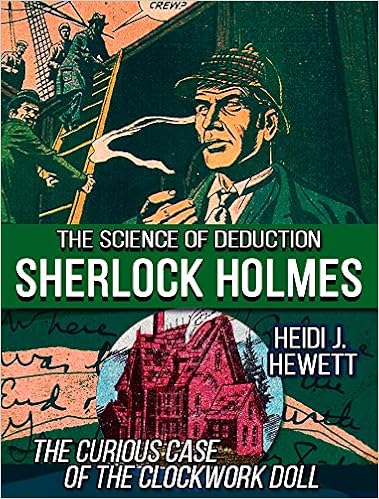
The first of these, The Curious Case of the Clockwork Doll, kicks the series off to an admirable start. The author, Heidi Hewitt, has captured Doyle's Watson-voice to a remarkable extent, and the classic elements - Baker Street, Lestrade, Holmes' eventual retirement to beekeeping- and references to other cases abound. An overabundance of these often works to the detriment of a pastiche work, but here it doesn't quite get that bad. I did question Lestrade's presence once Holmes and Watson leave London, but I suppose he also tagged along to Baskerville Hall, so perhaps his jurisdiction is flexible like that.

As the title of both the story and this post allude to, however, there's one element of this story that is distinctly un-Doyle-like - the clockwork robots that make up the client's serving staff. It takes a deft hand to add science-fiction elements like this to a historical setting without turning it into a parallel timeline, but as the story ends with the technology lost - in a fairly spectacular scene I think was the best-written in the piece - history can proceed unimpeded. The technology itself is only described in broad strokes, which makes sense as Watson is probably not up on the cutting edge of scientific theory, but a bit more explanation, even techno-babble, would have helped to sell the existence of these robots in 19th-century England, when the outpace even today's efforts.

Of course, with a mystery story the most important element is the solution, and here again is evidence of the author's painstaking craftsmanship - the denouement leaves no hanging threads (even to a seemingly unrelated robbery that I assumed was there to provide a cameo for one of the famous literary gentlemen thieves contemporary with Holmes) and, though surprising, in retrospect could have been figured out ahead of time, particularly for those with a Holmes-like memory for the details of the Sherlockian Canon. Even for readers without that, however, it was a very enjoyable story and I for one am greatly anticipating the second installment in this series.

(Disclaimer: the publisher provided me with a review copy of this story - my opinions, however, are all my own.)

Sunday, September 30, 2012

The Dresden Files: Latest & First

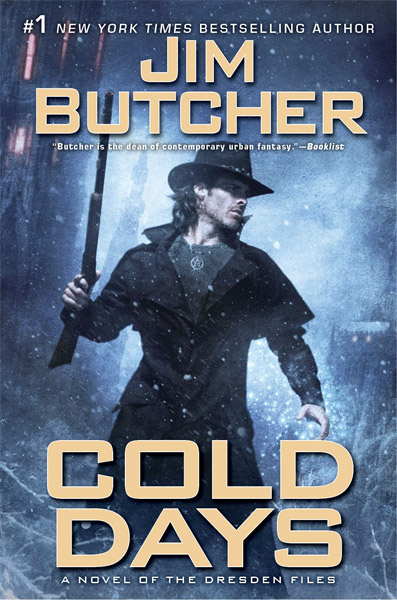
About a month ago, news broke that the latest novel in the Dresden Files series, Cold Days, will be released on November 27th.  Also revealed were the cover design and descriptive blurb:

HARRY DRESDEN LIVES!!!

After being murdered by a mystery assailant, navigating his way through the realm between life and death, and being brought back to the mortal world, Harry realizes that maybe death wasn’t all that bad. Because he is no longer Harry Dresden, Chicago’s only professional wizard.

He is now Harry Dresden, Winter Knight to Mab, the Queen of Air and Darkness. After Harry had no choice but to swear his fealty, Mab wasn’t about to let something as petty as death steal away the prize she had sought for so long. And now, her word is his command, no matter what she wants him to do, no matter where she wants him to go, and no matter who she wants him to kill.

Guess which Mab wants first?

Of course, it won’t be an ordinary, everyday assassination. Mab wants her newest minion to pull off the impossible: kill an immortal. No problem there, right? And to make matters worse, there exists a growing threat to an unfathomable source of magic that could land Harry in the sort of trouble that will make death look like a holiday.

Beset by enemies new and old, Harry must gather his friends and allies, prevent the annihilation of countless innocents, and find a way out of his eternal subservience before his newfound powers claim the only thing he has left to call his own . . .

His soul.
Well, that sounds cool1. Lots of questions are raised by this, such as who the immortal Harry's supposed to kill is, and whether they're someone, or even a type of someone, we've met before. And it's very interesting that the blurb is already talking about Harry getting out of being the Winter Knight - I would have expected that arc to stick around for another few books, or maybe even until the end of the series.

That cover art is pretty interesting, too - now, in the past the cover art has never tracked too closely to the plot of the novel (it's never been inaccurate, save for that hat, mind you, but trying to divine plot details from the art has usually2 proven futile), but for this one we have a fairly major shift in that Harry's carrying a rifle instead of his staff. So that could indicate that Harry's going to be switching up and/or expanding his tactical repertoire, especially if this immortal person is someone he can't get out of killing.

Anyway, I'm quite excited about this news - hopefully the preview chapters will be up sooner rather than later (rumor is the first to are in the paperback of Ghost Story - I'll have to see if I can scrounge one of those up).

In the meantime, I've been thinking for a while of giving the whole series a re-read, and this seems like the proverbial opportune moment. Hopefully it'll also make for some good blogging!

Friday, July 27, 2012

Holmes for the Holidays

Something I've noticed over the past several months in my reading and film-watching habits recently has been a sharp increase in stories starring Sherlock Holmes. While I've long been a fan of the Greatest Detective, these things tend to come in waves, and right now the Holmes-wave is cresting.

Most obviously, the arrival of Sherlock Holmes: A Game of Shadows in theaters last December was an occasion of some welcome. I see that the first Guy Ritchie-directed Holmes adaptation came out during my own hiatus, and thus went uncommented on. I'll just take this opportunity to say that I found it an excellent movie, one that hewed close to the spirit of Doyle's stories, if not being perfectly accurate in every detail.

And I swear the tagline is an amusing coincidence.

The sequel is the pretty much the same, only more so. I do have a few quibbles with it - the liberties taken with the storyline were somewhat more noticeable, given that the film was adapting an existing Holmes story rather than making one out of whole cloth. I was also rather irritated at the fate of Irene Adler in the film, though I take some comfort from the fact that we never saw the body. So to speak.

Holmes and Watson, though, were in top form. Especially gratifying was the expanded use of Holmes' "plot-out-the-fight-in-slow-motion-in-advance" brawling technique, even considering the time that Holmes' meticulous sequence was derailed by a third party throwing a knife. And of course, his final encounter with Moriarty took this form as well, with amazing results. And let's not forget Watson -  I especially appreciated his use of deductive reasoning concerning Mycroft's appearance at his "bachelor party", as well as his penultimate confrontation with Colonel Moran.

Finally, I thought Jared Harris' portrayal of Professor Moriarty to be pretty good, with just the right amount of civility papering over seething menace. His plot was refreshingly prosaic, though it reminded me quite a bit - OK, it was pretty much identical - to the Fantom's plot in The League of Extraordinary Gentlemen. And we all know who he turned out to be:

Saturday, March 12, 2011

Hunting Up A Good Read

One of the biggest problems with being someone who loves to read is not, as one might expect, finding new things to read. No, these days the Internet will give you the full information on any book you might hear about, and probably recommend a hundred more for you that are vaguely related. The problem is time - at least for me, who at any given moment is probably working on several books at once, and has "to read" list rivaling an academic bibliography. So, it takes something fairly unusual to make me jump "out of order" in my reading list.

Handily, Something Fairly Unusual happened just the other week - two separate and very different online communities pointed me at Monster Hunter International by Larry Correia. It had already been slightly on my radar, but the revelation that there are a bunch of preview chapters available increased my interest significantly.

And boy, was I not disappointed. The main character of the book is a young accountant named Owen Pitt, who is recruited into the titular organization after his boss becomes a werewolf and attempts to eat him. Luckily, Pitt is a firearms enthusiast and all-around protagonist type and is able to not only escape with his life, but actually kill the monstrous manager (I suppose a fourteen story fall followed by a heavy desk landing on your head will kill just about anything not already dead). The rest of the book is his recruitment by and first job with MHI, the world's most renowned monster-hunting business.

"MHI" stands for "Monster Hunter International", the company as well as the book title. But you figured that out yourself.

It sounds like a common, almost clichéd setup, but the author does several interesting things with it. The most obvious is the guns - in many of these kinds of stories modern weaponry is either ineffective against the supernatural creatures, or just not mentioned as a potential resource. For MHI, however, "shoot it until it stops moving" is generally Plan A, and surprisingly enough it's usually effective enough to disable most monsters until they can be permanently disposed of.

Another interesting twist is that MHI is a private, for-profit business* rather than a government agency or a religious/academic association. While I'm sure this is not a unique idea, it is different enough to be noteworthy.

I was also intrigued by the world-building in the book. Correia took an unusual step, in my mind, of taking the standard horror-fantasy monsters - werewolves, vampires, zombies, and such - and adding not only the by-now-also-standard stable of H. P. Lovecraft-inspired creatures (an aside in the book reveals that Lovecraft got some of his inspiration from hanging around with Hunters), but also a trailer-park full of elves and a tribe of heavy-metal loving orcs living deep in the woods of Alabama (Tolkien apparently knew some Hunters, too). The latter of these even fight alongside our protagonists, showing up at the climax with horse-trailers full of giant riding wolves. Does Scott Oden know about this?

Anyway, although it definitely take more than good ideas to make a good writer, Correia is no slouch in the wordsmith department, either. Monster Hunter International is a fast-paced read, and one that mixes suspense and action with a decent dose of humor, especially of the sarcastic first-person-narration kind. Owen Pitt and Harry Dresden would probably either get along fantastically, or hate each other. Possibly both.

Now, I don't want to give the impression that the book has no flaws at all - I did notice a few issues, mostly about characterization (certain portions of Pitt's biography read suspiciously close to the author's). However, despite this I enjoyed reading it very much, and would not hesitate to recommend it to others. I'll definitely be getting the sequels (numbering two at present), too. As if I hadn't spent the first paragraph of this post complaining about how I have no time to read the books I already have . . .

*Albeit one that derives much of its income from Federally-funded monster bounties. This is one of the reasons I hesitate to label this book the first Libertarian Urban Fantasy to come to my attention (the second being that my bestowing such a label would be pretentious and silly).