Over the years, I've enjoyed music from a wide variety of genres and styles. Lately, I've been really into Sabaton, a metal band out of Sweden. Taking their name from the technical term for a piece of armor covering the foot, their songs, for the most part, have a historical focus to them, mostly (as you might imagine) memorializing various wars and battles.
This focus has enabled the band to engage in some interesting and unusual promotional collaborations. One such is Sabaton History, a YouTube channel hosted by popular Internet-based historian Indy Neidell that examines the background of a given songs' subjects. For example, one of my favorite Sabaton songs is "Blood of Bannockburn", about the Scottish wars for independence:
Much to my delight, the second ever episode of Sabaton History covered the song; explaining the greater historical context, the immediate tactical byplay, and even the writing of the song:
While an excellent example of the format of the show, it is a bit atypical in that subject isn't from one of the World Wars of the early 20th Century. If I have one criticism of the show, it's that it does tend to focus on that era - and to be fair, not only does it appear to be Neidell's historical specialty, but Sabaton just this summer released The Great War, an entire album of songs about that conflict.
While metal often has something of a dark reputation, and indeed neither Sabaton's songs nor their history videos shy away from the realities of war and bloodshed, they never fall into a meaningless, nihilistic glorification of violence. Much to the contrary, the subjects they choose primarily exemplify virtues like courage and faithfulness, even in the face of overwhelming odds, and ensure that the stories of these heroes - individuals and armies - are remembered for another generation.
Once upon a time, there was a BBC car show called Top Gear. It was a fun little show that eventually became popular even outside England, due in large part to the three hosts - Jeremy Clarkson, James May, and Richard Hammond - whose camaraderie, automotive knowledge, and general attitude of amateurish enthusiasm made what could have been a boring news show into an award-winning phenomenon.
Unfortunately, even the most popular TV programs have the detractors, and over the years Top Gear received many complaints, not an insignificant number of which involved Jeremy's humor not being appreciated by humorless scolds. Even more unfortunately, some of these scolds were executives at the BBC, and eventually an excuse was found (a fistfight with a producer, or something) to kick Jeremy off the show. James and Richard resigned in protest, the BBC hired a carefully diverse array of forgettable replacements (the only one who sticks in the memory being Joey from Friends), and it looked like the spirit of Top Gear would be gone forever.
But then, Clarkson, May, and Hammond got together with one of the producers whom Jeremy didn't punch, got in contact with Amazon, and we all got to go on the Internet and find this:
I really like this whole opening sequence, not just because it marks the beginning of a terrific show (The Grand Tour is basically Top Gear with everything the BBC could legally block removed or altered), but as a piece of art in its own right. The choice of the Hothouse Flowers' cover of "I Can See Clearly Now" works really well as the mood swings from dour to triumphant, and is perfectly timed to little moments like Jeremy's face lighting up when James and Richard's muscle cars catch up with his. Best of all is the moment when the saxophone solo revs up, and the hosts are joined by a magnificent escort of cars from across automotive history. From modern supercars to pulp-era touring models, standard-issue daily drivers to outrageous art cars . . . now there's a diversity worth celebrating!
A few days ago, the news broke that Earl Scruggs had died. Now, as important a figure to Bluegrass music as he was, I can't say I was a huge fan - though what music of his I have listened to, I've enjoyed.
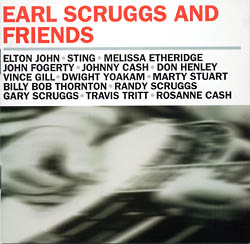
In fact, one of the first CDs I ever purchased was one of his, to be precise his 2001 album Earl Scruggs and Friends. Though it didn't inspire me to seek out more Scruggs specifically, I do think it helped shaped my taste for country music in general. One track notable in this regard is his cover of "Ring of Fire" with Billy Bob Thornton, which I actually prefer to Johnny Cash's version. Sorry, Johnny, but compared to Earl's your version sounds way too much like a Mariachi band.
But the most important, and certainly the most well-known, track from that album was a new version of "Foggy Mountain Breakdown". In my opinion Scruggs and company earned the Grammy this recording won them, and from the look of the video they had a blast laying it down:
Even though it's "just" the musicians in the studio, there's something about this video - like all good music videos - that makes it a joy to watch as well as listen to. Not just for the celebrity-spotting - yes, that's Steve Martin playing a banjo, and Wikipedia informs me that the gleeful maniac on the piano is Paul Shaffer - but the way each player gets some time as the primary focus, with said focus eventually returning to Scruggs himself is artfully done. And, as I said, the sheer joy evident in the various performances* is somewhat infectious - it's hard to keep from smiling while even listening to this piece.
And that, perhaps, is the best legacy any performer can have. Even though I have only a dim understanding of Earl Scruggs' legacy, I'm still grateful for the music he's left us with - and perhaps in the future I'll be inclined to listen to more of it.
*Well, except for the hirsute fellow on the keyboard - whenever the camera is on him he stays pretty Zen.
With a crew of drunken pilots, we're the only airship pirates!
We're full of hot air and we're starting to rise
We're the terror of the skies, but a danger to ourselves!
Over the last decade or so, untold amounts of digital ink have been spilt trying to define the term "Steampunk". Part of the problem is that steampunk is more of a stylistic genre than anything else, and as such can be applied to film, or literature, or prop-making, or music, or pretty much any other form of art.
Now, while I've been interested in the genre since I first heard of its existence* that last category, steampunk-as-music-genre, didn't really appeal. Back in 2008, however, I came across a reference to a little ditty called "Airship Pirates", by a group called Abney Park. An intriguing title, to say the least. Once I had tracked down and listened to the song, well, I really liked what I heard:
Unfortunately,none of the other songs on their "Lost Horizons" album really grabbed me in quite the same way - not even the incongruously upbeat (not to mention plot-relevant) "Post-Apocalypse Punk". So, I bought a copy of "Airship Pirates" as a single, and went on my merry way.
A couple of years later, I heard a rumor that "The Wrath of Fate", a song from the band's new album, was something of a sequel to "Airship Pirates". Now, I'm a big fan of gratuitous continuity, so I decided to give it a shot.
Now, that's more like it. As I poked around, I discovered that the new album - called The End Of Days - takes "gratuitous continuity" to a level possibly unheard of in the music industry.
It seems that, since Abney Park decided to brand itself as a "steampunk band", they've been using their songs to create a fictional background for themselves; a complex story involving time travel, accidental apocalypses ("plot-relevant", remember?), and of course Airship Piracy. In recent months, they've even branched out into a role-playing game and upcoming novel further exploring the setting.
But even without this lovingly crafted backstory, many of the songs from The End of Days (as well as their previous album, Æther Shanties) are quite enjoyable themselves. I would especially point out the aforementioned "The Wrath of Fate", "To the Apocalypse In Daddy's Sidecar", and "Neobedouin", from the former; and "Building Steam" and "The Clockyard" from the latter, as being well worth a listen.
With these last few albums, Abney Park has easily made itself one of the most unique-sounding bands I've ever heard. Even if they have written a philosophically questionable lyric or two (I'm still trying to work out whether the references to Christianity in "I've Been Wrong Before" are complimentary or not), I will be quite interested in whatever they end up doing next.
They're certainly better musicians than they are pirates, at least . . .
*The date of which, for the historically minded, I can only say (though with some certainly) was between 4 November 2004 and 23 February 2007.




 Posts
Posts

